
Beyond Pass Rates: Why Clinical Judgment Is the Measure of Nursing Readiness
Table of Contents
Name of the heading 1
1- Start your table with the syntax {start-table}
2 - Add an H3 Heading to create a new column (this will be the column title)
3 - List cells as bullet points in a List element
4 - End your table with the syntax {end-table}
The nursing profession stands at a critical inflection point. NCLEX pass rates for first-time U.S.-educated nurses consistently average around 88%, reflecting the dedicated work of nurse educators across the country. High pass rates don't happen by accident; they reflect intentional curriculum design, thoughtful teaching, and deep commitment to student success.
But here's the question healthcare leaders are increasingly asking: Does passing NCLEX mean a graduate is truly ready for practice?
The reality confronting workforce leaders and nursing deans today is stark: new graduate nurses are facing significant challenges in the transition to practice, with national data indicating that up to 30% leave their first position within the first year, often citing lack of confidence and inadequate preparation. Studies consistently document high stress levels during that critical first year, not because graduates lack knowledge, but because they struggle with the dynamic complexity of real clinical environments.
The distinction matters. Graduation and licensure tell us who is eligible to practice. Clinical judgment tells us who is ready.
The Gap Between Eligibility and Readiness
NCLEX pass rates measure content knowledge, pattern recognition, and test performance in a controlled testing environment. These are important foundational skills, essential quality indicators that reflect minimum competence for safe entry into practice.
But practice readiness requires more: the ability to prioritize competing demands in real time, escalate appropriately as conditions evolve, communicate effectively under pressure, and maintain situational awareness in dynamic clinical situations. These capabilities are more fully observed in simulation and clinical settings than on a standardized exam.
Healthcare organizations feel the downstream effects daily. Residency programs report spending significant time assessing clinical judgment gaps that weren't visible during pre-licensure education. Generic onboarding plans struggle to address individual development needs. The inconsistency in pre-licensure preparation means workforce leaders can't reliably predict which new graduates will adapt quickly and which will require extended support.
As the National Council of State Boards of Nursing defines it, clinical judgment is "the observed outcome of critical thinking and decision-making in context." Licensure exams assess this indirectly, but practice demands it continuously. The challenge for nursing education has been making clinical judgment visible during training so that targeted intervention becomes possible before high-stakes transitions.
This readiness gap doesn't belong to academia alone. It's shared across education, healthcare systems, and regulation. But educators are uniquely positioned to influence it because they shape how clinical judgment is formed before practice begins.
Where VR Simulation Creates Visibility
Virtual reality simulation addresses this visibility challenge in ways that traditional methods cannot match. By creating safe, repeatable practice environments, VR allows students to develop clinical judgment through exposure to realistic scenarios without risk to actual patients. Students can practice the same complex case multiple times, building pattern recognition and decision-making confidence at a scale that limited clinical placements or manikin-based labs cannot replicate.
Simulation surfaces judgment, not just knowledge. It introduces ambiguity, adds contextual complexity, and allows educators to observe decision-making in real time. Educators can see not just what learners choose, but how they arrive at their decisions.
But the real transformation comes from what VR simulation captures: comprehensive performance data across every learner interaction. Every assessment performed, every medication administered, every communication exchange, every prioritization decision generates data that can reveal patterns in clinical judgment development.
This is where artificial intelligence elevates simulation from a teaching tool to a strategic asset for workforce preparation.
AI-Enhanced Analytics: Making Patterns Visible
If simulation is where judgment shows up, debriefing is where it's built. The literature consistently shows that well-structured debriefing improves clinical reasoning, decision-making, and learner confidence. Yet even experienced nurse educators face real constraints: limited time between scenarios, multiple learners to observe simultaneously, cognitive overload from tracking numerous performance indicators while maintaining psychological safety.
These challenges create predictable impacts: time pressure forces rapid decisions about what to debrief without seeing the full picture; subjectivity means attention naturally goes to the loudest moment or most dramatic error while quieter patterns slip by unnoticed; inconsistency means two learners with similar judgment patterns may receive very different feedback depending on who facilitated the session.
Without visibility into patterns, even expert educators can miss what matters most. This isn't a critique of educator skill; it's an acknowledgment of cognitive load and human limitation in complex teaching environments.
AI-enhanced analytics change what's visible. By analyzing performance across simulations, AI can identify patterns that individual faculty members might miss: a cohort consistently struggling with medication administration timing, certain students excelling at initial assessment but missing critical escalation cues, specific clinical judgment competencies that need curricular attention.
These insights align directly to NCLEX Client Needs categories and clinical practice competencies, giving educators concrete data to guide debriefing conversations. Rather than generic reflection questions, facilitators can ask targeted questions based on observed performance patterns: "You assessed vital signs in 23 of 38 sessions at 61% completion. How might timely assessment impact patient outcomes in deteriorating conditions?"
The result is debriefing that builds clinical judgment systematically rather than hoping students will discover their gaps through trial and error in actual clinical settings.
Creating Consistency That Honors Educator Expertise
One concern nursing leaders often raise about AI in education is whether technology will replace the nuanced judgment that experienced educators bring to teaching. Evidence from early adopters suggests the opposite: AI analytics amplify educator effectiveness by reducing cognitive load and revealing patterns that inform rather than replace professional judgment.
When faculty see aggregate data showing students across multiple sections consistently miss certain critical actions, curriculum adjustments become evidence-based rather than anecdotal. When debriefing focuses on specific, data-supported performance gaps rather than general impressions, students receive more actionable feedback. When performance patterns are visible across time, early intervention becomes possible before students reach high-stakes clinical experiences.
This consistency matters enormously for workforce preparation. Healthcare organizations partnering with nursing programs using data-driven simulation approaches report that new graduates arrive with clearer self-awareness of their development areas and more consistent foundational competencies.
Following Learners Across the Education-to-Practice Continuum
Perhaps the most promising aspect of AI-enhanced simulation is its potential to create continuity across the transition to practice. Performance data from pre-licensure simulation can inform residency program design, allowing workforce development teams to focus coaching where individual nurses need it most rather than applying one-size-fits-all orientation plans.
Imagine a new graduate nurse arriving at their first position with a portfolio showing strong performance in assessment and basic care but documented gaps in prioritization under pressure. The residency program can immediately provide targeted support in that specific area, accelerating the nurse's confidence and competence while reducing time-to-independent-practice.
This represents a fundamental shift from hoping new graduates are ready to knowing where they excel and where they need support. For employers, it means nurses who can think, prioritize, and act from day one, not with the wisdom of 20-year veterans, but with a foundation that's been intentionally developed, consistently reinforced, and objectively measured.
Making the Strategic Case for VR Investment
For deans and workforce leaders evaluating VR simulation investments, the question ultimately comes down to return on investment. Traditional metrics (cost per student contact hour, pass rates, student satisfaction) remain important. But the strategic value of VR with AI analytics extends beyond these measures:
- Scalability: VR simulation enables consistent, high-quality experiences for every student, regardless of clinical placement availability or faculty-to-student ratios.
- Actionable insights: Performance analytics transform simulation from an educational activity into a strategic workforce development tool that generates insights for curriculum improvement and individualized coaching.
- Workforce alignment: By making clinical judgment visible and measurable during training, VR with AI analytics helps ensure graduates meet the practice-readiness expectations of healthcare employers, directly impacting retention and patient safety.
- Academic-practice partnerships: Nursing programs that can demonstrate data-driven approaches to clinical judgment development create stronger partnerships with healthcare organizations seeking practice-ready graduates, differentiating themselves in competitive markets.
The Path Forward
The nursing workforce challenges facing our healthcare system won't be solved by any single intervention. But as evidence accumulates about the gap between eligibility and readiness, the case for technologies that make clinical judgment visible and measurable becomes increasingly compelling.
Pass rates open the door to practice. Clinical judgment determines what happens once nurses step inside. VR simulation with AI-enhanced analytics represents an evolution in how we prepare nurses, moving from hoping students develop clinical judgment through exposure to systematically building and measuring these competencies throughout their education.
For nursing leaders committed to graduating workforce-ready nurses, it's an investment worth serious consideration.

Give your learners hands-on clinical simulation training that builds confidence, improves decision-making, and prepares them for real-world patient care in a safe, scalable virtual environment.
FAQs
Heading 1
Heading 2
Heading 3
Heading 4
Heading 5
Heading 6
Lorem ipsum dolor sit amet, consectetur adipiscing elit, sed do eiusmod tempor incididunt ut labore et dolore magna aliqua. Ut enim ad minim veniam, quis nostrud exercitation ullamco laboris nisi ut aliquip ex ea commodo consequat. Duis aute irure dolor in reprehenderit in voluptate velit esse cillum dolore eu fugiat nulla pariatur.
Block quote
Ordered list
- Item 1
- Item 2
- Item 3
Unordered list
- Item A
- Item B
- Item C
Bold text
Emphasis
Superscript
Subscript
Traditional debriefing relies on what educators observe and remember during simulation sessions, which can be limited by time constraints, cognitive load, and the challenge of tracking multiple learners simultaneously. AI-enhanced debriefing complements educator expertise by surfacing performance patterns across multiple simulations that might otherwise be invisible. It provides objective data on clinical judgment development, maps performance to NCLEX Client Needs categories, and enables more targeted, consistent feedback. Think of it as giving educators a clearer lens to see what learners are doing, not replacing the critical human element of coaching and mentorship.
No. AI-enhanced analytics are designed to amplify educator effectiveness, not replace nursing judgment. The technology handles data analysis and pattern recognition, freeing educators to focus on what they do best: building relationships with learners, facilitating meaningful debriefing conversations, and applying clinical expertise to guide student development. Faculty remain essential for interpreting data in context, understanding individual learner needs, maintaining psychological safety, and making pedagogical decisions. AI provides the visibility; educators provide the wisdom, empathy, and professional judgment that transform data into meaningful learning experiences.
When nursing programs use AI-enhanced simulation analytics throughout their curriculum, graduates develop deeper self-awareness of their clinical judgment strengths and growth areas. This data can follow learners into practice, giving transition-to-practice programs and nurse residencies a clear starting point for individualized development plans rather than generic orientation checklists. For example, if simulation data shows a new graduate excels at patient assessment but needs additional support in prioritization under time pressure, preceptors can focus coaching efforts precisely where needed. This targeted approach accelerates confidence, reduces time-to-independent-practice, and supports better retention by helping new nurses feel more prepared for the realities of clinical care.


Margaret "Maggie" Major is a dynamic educator and innovator in the field of nursing education. With an Ed.S. in Education specializing in Educational Technology from Walden University, Maggie brings a wealth of experience from her roles in secondary and post-secondary education. Her expertise spans curriculum development, online learning, and educational technology integration, making her an invaluable asset in advancing nursing education through cutting-edge simulation software. Her background as a Nurse Aide Program Coordinator and long-standing Adjunct Faculty member at Harrisburg Area Community College has given her unique insights into the evolving needs of nursing education. By championing the use of simulation and technology in nursing education, Maggie is playing a crucial role in shaping the future of healthcare education, preparing nurses who are confident, competent, and technologically adept for the challenges of modern healthcare delivery.

Christine Vogel is a clinical nurse, simulationist, and nurse educator who believes in the capacity of every nurse learner to realize their full potential by engaging in deliberate practice and choosing to start with the "Basic Assumption" that everyone is intelligent, capable, cares about doing their best, and wants to improve. As Lead Nurse Educator at UbiSim, Christine is actively engaged in designing, piloting, and evaluating evidence-based immersive VR simulations for nurse learners. In addition to her 25+ years in nursing, she has over a decade of experience in nursing academia where she developed, facilitated, and evaluated high-fidelity simulations in virtual reality as well as other modalities.
Explore more
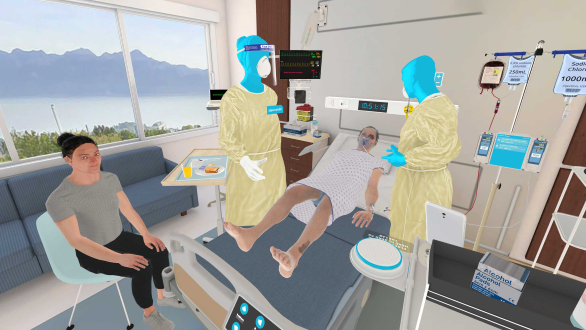
Teaching Clinical Judgment With UbiSim Multiplayer VR
Teach nursing learners to communicate when someone else is in the room, with pre-brief, role, and debrief tips for multiplayer VR simulation.
.jpg)
What a UbiSim VR Simulation Partnership Looks Like
From picking VR software to building faculty confidence, here's what a real clinical partnership with UbiSim looks like, from a nurse who lives it daily.
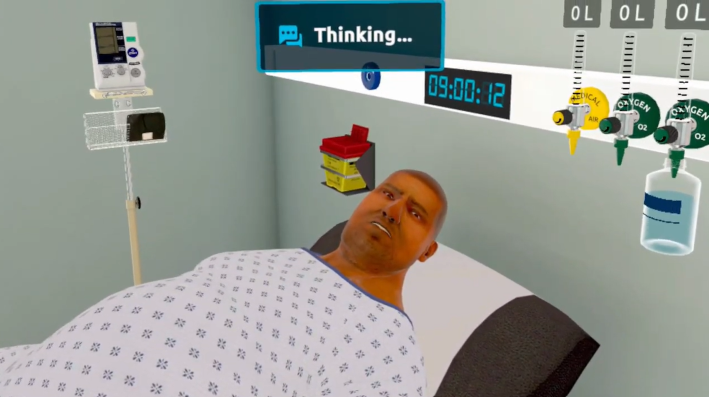
The Benefits of AI Patient Dialogue in VR Nursing Simulation
AI patient dialogue brings real conversation practice to VR nursing simulation, building learner confidence and empathy while helping programs scale smarter