Why Q1 Decisions Determine Your Nursing Workforce Pipeline

Table of Contents
Name of the heading 1
1- Start your table with the syntax {start-table}
2 - Add an H3 Heading to create a new column (this will be the column title)
3 - List cells as bullet points in a List element
4 - End your table with the syntax {end-table}
Nursing workforce shortages are often discussed as downstream problems, visible at the bedside or during hiring cycles. In reality, the most consequential decisions shaping workforce supply happen much earlier.
For many programs and systems, January through March determines how many nurses ultimately reach practice that year.
Demand for nursing education remains high across the U.S. and Canada. Qualified applicants continue to apply in strong numbers. Yet programs routinely turn away capable learners, not because of interest or aptitude, but because training capacity cannot absorb them.
This is not a recruitment problem. It is a throughput problem.
And it is one that becomes far harder to solve once the semester is underway.
The Nursing Workforce Paradox: High Demand, Limited Capacity
The nursing workforce pipeline narrows long before graduation.
Faculty shortages limit how many learners programs can admit and consistently support. Clinical placement availability remains unpredictable, increasingly competitive, and uneven across regions, particularly in rural and underserved areas. These constraints are well documented, but their compounding effect is often underestimated.
Once faculty capacity is exceeded or clinical access tightens, every other workforce lever becomes constrained. Cohort sizes stall. Progression slows. Attrition risk increases. And the number of nurses entering the workforce shrinks before licensure even comes into view.
Long-term workforce projections reinforce the urgency. National and state data continue to show sustained nursing shortages well into the next decade. Delayed action today compounds future gaps.
The result is a persistent paradox: strong demand, but limited institutional capacity to move learners from admission through graduation and into practice.
Why Timing Matters: Q1 Is the Workforce Decision Window
While workforce outcomes are often assessed at the end of the academic year, they are largely determined at the beginning.
Q1 is the point at which institutional flexibility still exists. After that, options narrow.
Between January and March:
- Budgets activate and spending authority opens
- New PN, ADN, and BSN cohorts begin
- Clinical site availability becomes clear or constricted
- Faculty workload intensifies
- Early assessments reveal where learners need additional support
By mid-semester, many structural decisions are already fixed. Enrollment levels, instructional models, and clinical access patterns are no longer easily adjusted. At that point, leaders are managing consequences rather than shaping outcomes.
This is what makes Q1 different from the rest of the year. Decisions made during this window still have leverage.
How Scalable VR Strengthens the Nursing Workforce Pipeline
When timing is this consequential, the critical question becomes practical: what can be implemented quickly enough to influence outcomes this semester?
Traditional solutions, such as expanding clinical partnerships, hiring additional faculty, or redesigning curricula, are important but slow-moving. They rarely resolve immediate Q1 constraints.
Scalable simulation, including immersive VR, passes the timing test.
UbiSim’s immersive VR simulation provides on-demand, standardized clinical experiences that help programs respond immediately to early-year capacity pressures. When implemented early in Q1, VR allows institutions to supplement clinical learning without waiting on additional sites, faculty lines, or long planning cycles.
Early adoption enables programs to:
- Expand effective training capacity when clinical placements are limited or disrupted
- Build clinical judgment and communication consistently across large cohorts
- Identify learners needing additional support early, enabling timely, targeted practice
- Reduce instructional strain by supporting faculty at scale without diminishing quality
Research and program evaluations have shown that immersive VR simulation, including platforms like UbiSim, can strengthen clinical judgment, communication, and learner confidence. These capabilities are essential to sustaining a stable nursing workforce pipeline.
Importantly, VR does not replace clinical education. It reinforces it, providing a reliable, immediately deployable layer of training that preserves learner momentum when traditional resources are constrained.
The Cost of Waiting
One of the most common workforce planning missteps is assuming capacity challenges can be addressed later in the year.
When programs defer action in Q1, the costs are structural and cumulative:
- Enrollment opportunities are lost as capacity limits harden
- Learner momentum erodes without early support
- Attrition risk increases as gaps go unaddressed
- Fewer learners progress to graduation and into the workforce
These losses may not be immediately visible, but they narrow the pipeline well before the semester ends and long before leaders have meaningful opportunities to intervene.
By contrast, programs that act early retain flexibility. They stabilize cohorts as they form, respond to clinical disruptions in real time, and protect progression when pressure peaks.
In workforce development, timing is the multiplier.
Rising System and Policy Expectations
At the same time, expectations placed on nursing education continue to rise.
States and regions are prioritizing nursing workforce development through targeted funding and accountability frameworks. Health systems are asking education partners to produce more practice-ready nurses, faster. Workforce initiatives increasingly demand measurable progress tied to capacity expansion, access, retention, and readiness.
Workforce development is no longer aspirational. It is accountable.
For system-level leaders, this means academic planning must align with workforce timelines, not just academic calendars. Institutions are evaluated not only on outcomes, but on how quickly they can demonstrate progress.
Aligning Q1 Strategy With Workforce Outcomes
The nursing workforce pipeline is not shaped by a single technology or semester. It is shaped by when leaders act.
Those who treat Q1 as a strategic workforce moment, rather than a routine academic reset, are better positioned to:
- Admit and support more learners
- Reduce avoidable attrition
- Graduate more practice-ready nurses
- Meet state, system, and community workforce expectations
The challenge facing nursing education today is not whether demand exists. It is whether leaders act early enough to keep the pipeline moving.

Give your learners hands-on clinical simulation training that builds confidence, improves decision-making, and prepares them for real-world patient care in a safe, scalable virtual environment.
FAQs
Heading 1
Heading 2
Heading 3
Heading 4
Heading 5
Heading 6
Lorem ipsum dolor sit amet, consectetur adipiscing elit, sed do eiusmod tempor incididunt ut labore et dolore magna aliqua. Ut enim ad minim veniam, quis nostrud exercitation ullamco laboris nisi ut aliquip ex ea commodo consequat. Duis aute irure dolor in reprehenderit in voluptate velit esse cillum dolore eu fugiat nulla pariatur.
Block quote
Ordered list
- Item 1
- Item 2
- Item 3
Unordered list
- Item A
- Item B
- Item C
Bold text
Emphasis
Superscript
Subscript
Q1 decisions matter because January through March is when budgets activate, cohorts begin, clinical access becomes clear, and early assessments surface learner support needs. Decisions made during this window determine training capacity, retention, and how many learners ultimately progress through the nursing workforce pipeline.
Virtual reality simulation supports workforce development by expanding access to consistent, on-demand clinical practice, strengthening clinical judgment and communication, and supporting learner progression when traditional clinical access is limited. This helps programs maintain pipeline stability and scale training capacity.
No. VR is not a replacement for clinical training. It serves as a high-quality supplement that strengthens learning, provides standardized practice opportunities, and supports learner readiness, especially when clinical placements are limited or uneven.



Tracy's work sits at the intersection of clinical learning and product strategy helping the field understand not just what VR simulation can do, but why it matters right now. She is passionate about connecting innovation with real-world impact and championing nurses at the forefront of one of healthcare's most critical transformations.
Explore more
.jpg)
What a UbiSim VR Simulation Partnership Looks Like
From picking VR software to building faculty confidence, here's what a real clinical partnership with UbiSim looks like, from a nurse who lives it daily.
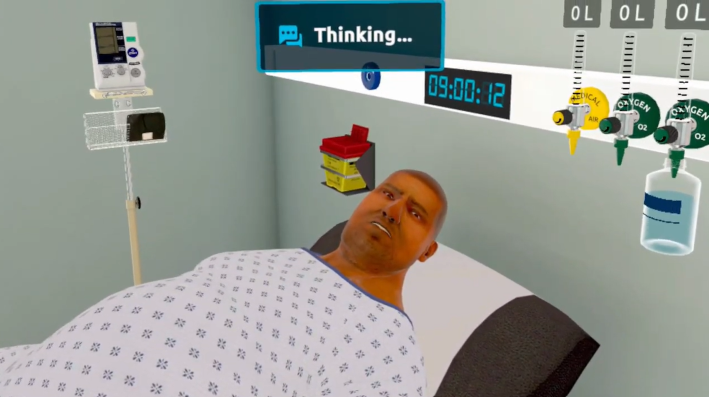
The Benefits of AI Patient Dialogue in VR Nursing Simulation
AI patient dialogue brings real conversation practice to VR nursing simulation, building learner confidence and empathy while helping programs scale smarter
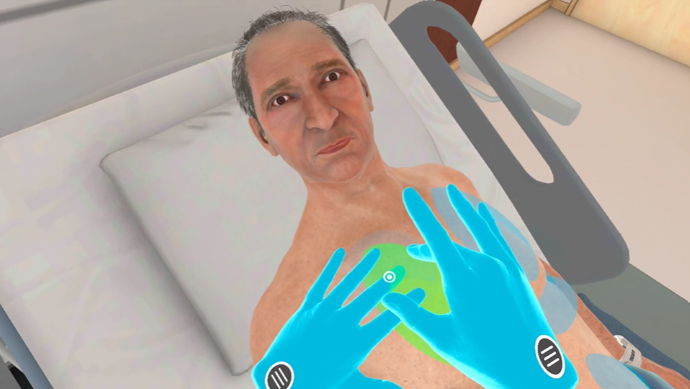
Enhanced Auscultation and Percussion Assessment
Explore UbiSim VR enhanced auscultation and new percussion assessment features built for nursing education