Why Academic-Practice Partnerships are the Future of Nursing

Table of Contents
Name of the heading 1
1- Start your table with the syntax {start-table}
2 - Add an H3 Heading to create a new column (this will be the column title)
3 - List cells as bullet points in a List element
4 - End your table with the syntax {end-table}
The $44 Million Question
What if you could eliminate "transition shock," retain 100% of your new graduates into year two, and save your health system tens of millions in turnover costs, all while expanding your program's enrollment capacity?
Health systems with formal Academic-Practice Partnerships (APPs) are already doing it. But here's what's changing the game: integrating immersive Virtual Reality into these collaborations is allowing partners to scale what was once limited by physical space, faculty availability, and scheduling constraints.
Why Academic-Practice Partnerships Matter Now
When graduates enter the workforce unprepared, everyone loses. The new nurse experiences "transition shock," the hospital burns orientation budgets on extended onboarding, and patient safety suffers during that critical competency gap. Traditional clinical rotations, where students rotate through units as temporary visitors, can't bridge this divide.
Academic-Practice Partnerships flip the model. Instead of students observing from the periphery, they're integrated as contributing team members. Instead of academic faculty working in isolation from clinical realities, hospitals and schools co-design curricula that produce day-one-ready graduates.
The results speak for themselves:
- 100% retention of nursing scholars through year two (compared to 43% industry average for new grads)
- Reduced orientation time from 6+ months to 8-12 weeks for partnership graduates
- $44 million in cost savings for one large health system through reduced turnover and agency staffing
- Measurable patient safety improvements, including dramatic reductions in hospital-acquired infections and pressure injuries
From Visitor to Valued Team Member: Sarah's Story
Meet Sarah, a senior nursing student, and Marcus, a veteran nurse on a high-vacancy medical-surgical unit.
The old way: Sarah would shadow Marcus for a few weeks, feeling more like a guest than a contributor. She'd graduate with a diploma but without the practical confidence to handle her first shift. Marcus would watch her leave, knowing she'd likely struggle and possibly quit within her first year.
The partnership way: Sarah joins Marcus's unit as a "nursing scholar" for her entire final year through a Dedicated Education Unit model—a formalized partnership structure where an entire hospital unit partners exclusively with one nursing program. Marcus, trained by the university to serve as a clinical instructor, becomes her mentor.
But here's where it gets interesting: Before Sarah ever sets foot on Marcus's unit, she's already practiced in Virtual Reality.
In UbiSim's VR environment, Sarah has already administered medications dozens of times, navigated workplace chaos with competing priorities and interruptions, practiced speaking up to physicians using assertive communication, and experienced patient perspectives through empathy-building scenarios.
When Sarah arrives on Marcus's unit, she's not starting from zero. Marcus can focus on advanced clinical reasoning instead of equipment orientation. The result: Sarah graduates genuinely practice-ready, and when she accepts a full-time position after graduation, there's no transition shock—just continuity.
According to a 2024 UbiSim survey, 75% of nursing students reported that VR simulation prepared them effectively for their future nursing roles.
Five Ways VR Strengthens Academic-Practice Partnerships
1. Standardized Competency Before Clinical Placement VR allows academic partners to certify that students meet specific safety thresholds before they enter the hospital environment. Faculty can remotely monitor performance metrics and provide targeted remediation. Hospital partners receive students who've already demonstrated baseline competency.
2. Practice Without Limits Physical simulation labs require scheduling, faculty supervision, and expensive equipment maintenance. VR headsets allow students to practice complex procedures—catheter insertion, wound care, medication administration—repeatedly, on their own schedule, until they achieve mastery.
3. Soft Skills That Matter Clinical judgment isn't just about technical skills. VR scenarios train students in the interprofessional communication, conflict navigation, and "speak-up" behaviors that prevent medical errors. These are the competencies that build confidence and reduce the anxiety that fuels transition shock.
4. Empathy Through Experience VR allows learners to experience healthcare from the patient's perspective, understanding the vulnerability, confusion, and fear patients feel. This enhanced empathy translates directly to improved communication and stronger therapeutic relationships in practice settings.
5. Remote Faculty Supervision One of the biggest barriers to expanding nursing program capacity is the clinical faculty shortage. VR enables one faculty member to supervise multiple students across different physical locations simultaneously, reviewing performance data and providing feedback remotely. This extends faculty capacity without compromising educational quality.
The Bottom Line: ROI That Hospital CFOs and Academic Deans Both Understand
For Health Systems: Reduced new graduate turnover saves $40,000-$64,000 per nurse retained. Shortened orientation periods free up preceptor time. Partnership graduates demonstrate higher patient safety scores. Built-in recruitment pipeline from students who already know your culture.
For Nursing Schools: Expanded clinical placement capacity without additional physical infrastructure. Joint faculty appointments address the clinical faculty shortage. Enhanced graduate employment rates strengthen program reputation. Access to cutting-edge clinical training environments improves accreditation outcomes.
For Students: Reduced anxiety and increased confidence through deliberate practice. Stronger sense of professional identity before graduation. Higher starting salaries due to demonstrated advanced competency.
Your Next Step
The nursing workforce crisis isn't waiting for perfect conditions. Neither should you.
Academic-Practice Partnerships expand capacity while improving outcomes. VR makes them scalable and measurable. Building these partnerships requires intentional structure—shared governance, joint faculty appointments, and integrated technology infrastructure.
Ready to explore how VR can strengthen your academic-practice partnership? The American Association of Colleges of Nursing offers a comprehensive Academic-Practice Partnership Playbook with implementation frameworks, and UbiSim can show you how VR integrates into each stage of the partnership model.

Give your learners hands-on clinical simulation training that builds confidence, improves decision-making, and prepares them for real-world patient care in a safe, scalable virtual environment.
FAQs
Heading 1
Heading 2
Heading 3
Heading 4
Heading 5
Heading 6
Lorem ipsum dolor sit amet, consectetur adipiscing elit, sed do eiusmod tempor incididunt ut labore et dolore magna aliqua. Ut enim ad minim veniam, quis nostrud exercitation ullamco laboris nisi ut aliquip ex ea commodo consequat. Duis aute irure dolor in reprehenderit in voluptate velit esse cillum dolore eu fugiat nulla pariatur.
Block quote
Ordered list
- Item 1
- Item 2
- Item 3
Unordered list
- Item A
- Item B
- Item C
Bold text
Emphasis
Superscript
Subscript
In traditional rotations, one faculty member supervises 8-10 students who rotate through multiple units, often feeling like temporary visitors. In a DEU model, an entire hospital unit partners exclusively with one nursing program. Staff nurses on that unit are trained as clinical instructors and mentor small groups of students (2-3 per nurse) throughout the students' final year. This creates continuity, deeper relationships, and a genuine sense of belonging. Students become contributing team members rather than observers, and hospitals benefit from their work while investing in their future workforce.
VR offers three critical advantages: unlimited repetition (students can practice procedures 50+ times instead of 2-3 times in a physical lab), remote faculty supervision (one instructor can monitor multiple students' performance data across different locations), and psychological safety (students make mistakes and learn from them without fear of harming real patients or looking incompetent in front of peers). This means hospital partners receive students who've already achieved baseline mastery of essential skills, allowing clinical time to focus on advanced reasoning and real patient care rather than basic task orientation.
Start with shared commitment before perfect planning. Leaders from both organizations should meet to identify mutual goals—whether that's expanding enrollment capacity, reducing turnover, or improving patient outcomes—and formalize the relationship with a Memorandum of Understanding (MOU) that outlines resource sharing, governance structure, and success metrics. The AACN/AONL Academic-Practice Partnership Playbook provides step-by-step frameworks for partnership development, including sample MOUs and governance models. Many successful partnerships begin with a small pilot program (one unit, one cohort of students) and expand based on demonstrated results.



Dr. Christine "Christy" Heid is a dedicated nurse educator, innovator, and simulationist with over two decades of experience. She holds a PhD in Nursing and has made significant contributions to nursing education, particularly in simulation-based learning and clinical judgment development. Dr. Heid is the creator of the Heid ATE Guide for Clinical Teaching and Learning©, an innovative tool designed to build nurses' clinical judgment skills. She is the former Chair of the INACSL Education Committee, a member of the OADN Simulation Committee, and a contributor to the Cornerstones of Best Practice, which explores the application of the Healthcare Simulation Standards of Best Practice™. Her work focuses on promoting innovative teaching strategies, simulation-based competency evaluation, and fostering deep learning across academic and practice settings to improve healthcare and educational outcomes.
Explore more
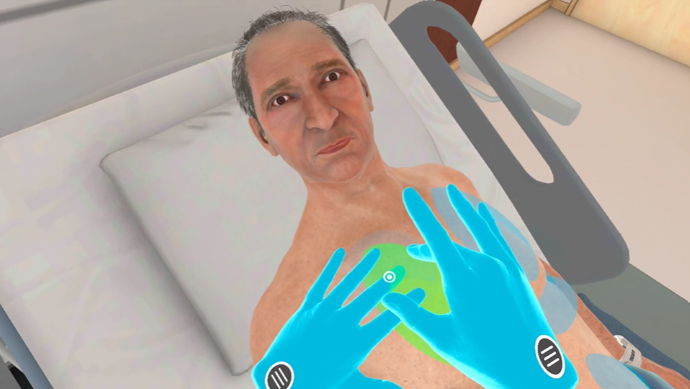
Enhanced Auscultation and Percussion Assessment
Explore UbiSim VR enhanced auscultation and new percussion assessment features built for nursing education

How Immersive VR Prepares Nurses for the Demands of Real Patient Care
Discover how immersive VR simulation builds clinical judgment and confidence in nurses using a real Med-Surg scenario as the guide.
%20(2).png)
The UbiSim Difference: Built, Designed, and Implemented by Nurses
Every step of the UbiSim experience is led by nurses. Discover what nurse-led VR simulation means for your nursing program.