Mitigating Medication Administration Errors: VR Training for New Nurse Transition
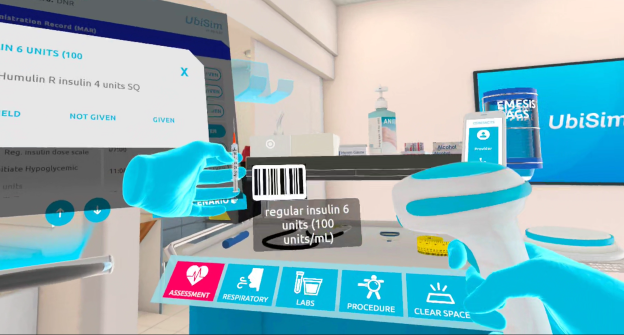
Table of Contents
Name of the heading 1
1- Start your table with the syntax {start-table}
2 - Add an H3 Heading to create a new column (this will be the column title)
3 - List cells as bullet points in a List element
4 - End your table with the syntax {end-table}
Leo's First Real Patient
Before his first shift in the Cardiac Care Unit, Leo spent dozens of hours in a high-fidelity VR simulation practicing the high-stakes task of preparing and administering anticoagulants, a medication class with zero margin for error.
In the virtual environment, Leo faced realistic distractions: a colleague asking a question, a nearby bed alarm, and a patient requesting water. Initially, these interruptions led him to skip a critical secondary verification step. But in this safe virtual space, he could pause, receive instant feedback, and restart the sequence. By the time he completed his training, the "Six Rights" were no longer a checklist; they were muscle memory.
When Leo finally stood at a real bedside, the environment felt familiar. While other new nurses might be overwhelmed by the hospital's sensory overload, Leo remained focused. He successfully identified a potential dosing discrepancy in a patient's chart before drawing up the medication, a catch he attributes directly to the rigorous, distraction-heavy training he received in VR.
Leo's story isn't unique. It's exactly what VR simulation is designed to achieve: transform new nurses from anxious novices into confident, competent practitioners before their first real patient encounter.
The Critical Cost of Medication Errors
For transition-to-practice leaders, the stakes couldn't be higher. Medication errors represent one of the most significant risks during a new nurse's first year, and the consequences extend far beyond patient safety:
- Financial Impact: Medication errors cost an estimated $42 billion annually worldwide, representing nearly 1% of total global health expenditure.
- Extended Hospital Stays: Patients who experience a preventable medication error spend an average of 4.6 days longer in the hospital, significantly increasing healthcare costs and resource utilization.
- Legal and Malpractice Costs: Hospitals and providers face substantial legal liabilities; the average settlement for a medication-related malpractice claim can exceed $100,000 per incident.
- Nurse Burnout and Turnover: Known as the "second victim" phenomenon, nurses involved in errors often experience severe psychological distress, increasing the likelihood of leaving the profession during their critical first year, and further exacerbating the costly nursing shortage.
- Loss of Patient Trust: Beyond immediate harm, errors erode public confidence in healthcare systems, leading to decreased patient compliance and poorer long-term outcomes.
Who are the nurses most vulnerable to these errors? New graduates during their orientation and residency periods. Transition shock, characterized by high stress, heavy workload, and unfamiliar systems, creates the perfect storm for preventable mistakes.
Why Consider VR in Your Transition-to-Practice Program?
Virtual Reality simulation provides a powerful, proven solution for reducing transition shock and building the competencies new nurses need before they're responsible for actual patients. Here's how VR transforms your nurse residency program:
- Building Muscle Memory for the "Six Rights": VR allows new nurses to repeatedly practice the Six Rights of medication administration (right patient, drug, dose, route, time, and documentation) in a safe environment. Repetition builds the instinctive responses needed in high-pressure clinical settings.
- Managing Cognitive Load and Distractions: Hospital units are full of interruptions and alarms that can lead to fatal errors. VR simulations mimic these real-world distractions, teaching new nurses how to maintain focus and prioritize safety protocols even when their cognitive load is high.
- Safe Exposure to High-Risk Scenarios: VR provides a fail-safe environment for residents to encounter and learn from rare but critical medication errors without risking actual patients. Simulated high-risk experiences allow nurses to recognize near-miss situations more effectively during their orientation period.
- Accelerating Time-to-Competency: By mastering intricate workflows and equipment in a virtual setting, new nurses transition from nervous observers to confident practitioners faster. Building foundational confidence allows graduate nurses to focus on clinical reasoning and patient assessment rather than fumbling with equipment mechanics.
- Standardized Competency Validation: VR ensures that every new hire receives the same high-level training on your hospital's specific safety protocols, regardless of which unit they're assigned to or which preceptor they work with during orientation.
Implementing VR in Your Nurse Residency Program
VR platforms like UbiSim provide high-fidelity, customizable simulations that address the high-stakes scenarios new nurses face during their first 90 days. Here's how focused scenarios build specific competencies:
Foundational Onboarding Skills
- Medication Administration Orientation: Master eMAR navigation and safe administration techniques across all routes
- Blood Glucose & Insulin Protocols: Link assessment findings to dosing decisions using sliding scale protocols
- Diabetes Management: Recognize hypo/hyperglycemia signs and respond with appropriate interventions–just in time for the new CMS glycemic control guidelines
Complex Dosage Calculation & High-Alert Medications
- Weight-Based IV Calculations: Build mathematical confidence for high-alert medications like Vancomycin
- Multiple IV Management: Handle simultaneous IV drips with different rates and compatibility requirements
- Emergency Titration: Develop decision-making speed for concurrent fluid and insulin management
Integrated Safety & Clinical Judgment
- Environmental Hazard Recognition: Identify near-miss scenarios before encountering them with real patients
- Pain Management: Balance opioid administration with respiratory monitoring and fall prevention
- SBAR Communication: Combine assessment, medication safety, and professional handoff skills
- Therapeutic Communication: De-escalate resistance while maintaining medication safety in challenging situations
Measuring Success: What to Track
When implementing VR in your transition program, focus on these key metrics:
- Time to independent practice: How quickly new nurses achieve competency validation milestones
- 90-day retention rates: Reduced turnover during the critical orientation period
- Incident reports: Decreased medication errors and near-misses among new residents
- Preceptor efficiency: Reduced burden on experienced staff during orientation
- Confidence assessments: Self-reported readiness levels before and after VR training
The Bottom Line
Virtual Reality isn't replacing your nurse residency program; it's strengthening it. VR offers a "flight simulator" for nursing that builds the confidence, competence, and muscle memory new nurses need before they independently administer medications and evaluate patient responses in your facility, bridging the gap between supervised practice and autonomous clinical decision-making.
By integrating VR into your transition-to-practice program, you're not just improving safety outcomes. You're protecting your organization's financial integrity, reducing turnover costs, and ensuring every new nurse arrives at the bedside prepared to deliver the level of care your patients deserve.
Ready to Evaluate VR for your Transition Program?
Consider auditing your current residency outcomes against these questions:
- How many medication incidents involve nurses in their first 90 days?
- What's your turnover rate during orientation?
- How standardized is your competency validation process across units?
The answers will show you where VR can make the biggest impact.

Give your learners hands-on clinical simulation training that builds confidence, improves decision-making, and prepares them for real-world patient care in a safe, scalable virtual environment.
FAQs
Heading 1
Heading 2
Heading 3
Heading 4
Heading 5
Heading 6
Lorem ipsum dolor sit amet, consectetur adipiscing elit, sed do eiusmod tempor incididunt ut labore et dolore magna aliqua. Ut enim ad minim veniam, quis nostrud exercitation ullamco laboris nisi ut aliquip ex ea commodo consequat. Duis aute irure dolor in reprehenderit in voluptate velit esse cillum dolore eu fugiat nulla pariatur.
Block quote
Ordered list
- Item 1
- Item 2
- Item 3
Unordered list
- Item A
- Item B
- Item C
Bold text
Emphasis
Superscript
Subscript
VR modules can be integrated into your current orientation schedule, typically requiring 2-4 hours per week during the first month. Most programs front-load VR training before unit-specific rotations begin, allowing new nurses to arrive with foundational competencies already established.
The average cost of turnover for a bedside RN ranges from $40,000 to $60,000, with orientation and training comprising a significant portion of these expenses. Reducing turnover during the critical first 90 days can result in substantial cost savings for your organization.
Yes. UbiSim VR's scenario editor allows you to customize scenarios to reflect your hospital's specific clinical situations, medication administration protocols, and workflows. This ensures new nurses practice decision-making that aligns with your organization's standards before they begin working independently in your facility.



Dr. Christine "Christy" Heid is a dedicated nurse educator, innovator, and simulationist with over two decades of experience. She holds a PhD in Nursing and has made significant contributions to nursing education, particularly in simulation-based learning and clinical judgment development. Dr. Heid is the creator of the Heid ATE Guide for Clinical Teaching and Learning©, an innovative tool designed to build nurses' clinical judgment skills. She is the former Chair of the INACSL Education Committee, a member of the OADN Simulation Committee, and a contributor to the Cornerstones of Best Practice, which explores the application of the Healthcare Simulation Standards of Best Practice™. Her work focuses on promoting innovative teaching strategies, simulation-based competency evaluation, and fostering deep learning across academic and practice settings to improve healthcare and educational outcomes.
Explore more
.jpg)
What a UbiSim VR Simulation Partnership Looks Like
From picking VR software to building faculty confidence, here's what a real clinical partnership with UbiSim looks like, from a nurse who lives it daily.
The Benefits of AI Patient Dialogue in VR Nursing Simulation
AI patient dialogue brings real conversation practice to VR nursing simulation, building learner confidence and empathy while helping programs scale smarter
Enhanced Auscultation and Percussion Assessment
Explore UbiSim VR enhanced auscultation and new percussion assessment features built for nursing education