How Immersive VR Prepares Nurses for the Demands of Real Patient Care

Table of Contents
Name of the heading 1
1- Start your table with the syntax {start-table}
2 - Add an H3 Heading to create a new column (this will be the column title)
3 - List cells as bullet points in a List element
4 - End your table with the syntax {end-table}
It's 0700 on the Medical-Surgical unit. You're the primary RN walking into Lucille Boughman's room for the first time.
She's 80 years old, admitted overnight with a confirmed partial adhesive small bowel obstruction. She hasn't been able to eat or keep fluids down in three days. Her abdomen is firm and distended. Her morning labs were drawn at 0600 but weren't ready when the surgeon came through. Now it's your job to assess her, act on the provider orders, and call the surgeon back with findings they haven't seen yet.
This is not a case study. There's no answer key at the bottom of the page. There is just Lucille, her vitals, her history, and whatever clinical judgment you can bring to bear.
That's exactly the point.
Why Knowledge Isn't Enough for Real Patient Care
Nurses enter clinical settings carrying a significant amount of knowledge. What they often lack is the experience of applying that knowledge under pressure, in real time, with a real patient in front of them. Lectures and case studies can build a foundation, but they don't replicate what it actually feels like to be the one responsible.
"Knowledge alone is not enough. Nurses need opportunities to practice decision-making in realistic environments," says Hayley Conner, Ed.D, MSN, RN.
That gap between knowing and doing is where clinical errors happen. It's also where VR simulation does its most important work.
How VR Simulation Teaches Clinical Judgment
The Lucille Boughman scenario was designed by Debra Loop, DNP, MSN, RN, CNE, CHSE, and it's a masterclass in clinical complexity. Lucille is not a straightforward patient. She's an 80-year-old with a history of hypertension, hyperlipidemia, Type II diabetes, and coronary artery disease. She has a DNR. Her labs are pending. Her vitals are trending in the wrong direction: heart rate 100, temp 100.9, respiratory rate 22, and she vomited 300 mL of yellow-green emesis just a few hours earlier.
The nurse's task is not to complete a checklist. It's to move through the full cycle of clinical judgment: recognize cues, analyze them, prioritize hypotheses, generate solutions, take action, and evaluate outcomes. Every decision in Lucille's room reflects the NCSBN Clinical Judgment Measurement Model, not as an abstract framework, but as something that has to happen in the next few minutes.
What's notable about the scenario design is what it doesn't do. It doesn't telegraph the right answer. It doesn't prompt the learner when something is wrong. It asks the nurse to notice that amber urine and a rising heart rate together mean something, and to decide what to do about it before the patient's condition changes.
That's the difference between performing nursing skills and thinking like a nurse.
Why Nurses Need a Safe Space to Get It Wrong
One of the hardest things to create in clinical training is a space where failure is formative rather than consequential. In a real patient room, the stakes are always real. In VR, they're not, and that changes everything.
Nurses can call the provider, stumble through SBAR, and try again. They can miss a cue on the first run and catch it on the second. The scenario can be reset, reassigned, and embedded wherever it's most useful, not just in a sim lab once a semester, but as a pre-clinical prep activity, a component of a flipped learning experience, or part of ongoing professional development for practicing clinicians.
This flexibility matters because readiness isn't a one-time event. It's built through repeated, meaningful practice across a career, from pre-licensure through transition to practice and into continuous development.
The Role of Debriefing in Nursing Simulation
The learning doesn't stop when the simulation ends. Structured debriefing is where nurses consolidate what just happened and connect it to what they'll do differently next time.
UbiSim supports that process through PEARLS-based guided reflection, asking nurses to examine their own abnormal assessment findings, consider Lucille's risk factors for adhesive SBO, and think through the ethical complexity of her DNR status and the conversation her family is asking to have. NCLEX-style quiz questions and an unfolding case study set 24 hours later extend the learning further, keeping the clinical judgment cycle active long after the headset comes off.
AI-Enhanced Analytics help educators and clinical educators make sense of performance data quickly, surfacing insights aligned to NCLEX categories so that debriefing conversations are grounded in what actually happened, not just what was observed.
The UbiSim Difference: Built By Nurses, For Nurses
None of this works without intentional design. UbiSim wasn't built by adapting existing simulation technology. It was built from the ground up for nursing simulation, by people who understand what clinical judgment actually requires and what it takes to build it safely.
Educators and clinical teams can create and modify scenarios without any coding, adjusting patient history, vitals, and lab results to match specific learning objectives. That means Lucille can be calibrated for a Med-Surg 2 learner today and reconfigured for a new graduate orientation cohort tomorrow.
Thinking like a nurse starts with feeling like a nurse. A psychologically safe environment is where that confidence begins, and VR simulation is where it gets built.
Experience the Scenario Yourself
Debra Loop and Hayley Conner walked through the full Lucille Boughman scenario live, including prebriefing, simulation, and debrief. Watch the full session on demand and experience the scenario for yourself.
Watch the webinar

Give your learners hands-on clinical simulation training that builds confidence, improves decision-making, and prepares them for real-world patient care in a safe, scalable virtual environment.
FAQs
Heading 1
Heading 2
Heading 3
Heading 4
Heading 5
Heading 6
Lorem ipsum dolor sit amet, consectetur adipiscing elit, sed do eiusmod tempor incididunt ut labore et dolore magna aliqua. Ut enim ad minim veniam, quis nostrud exercitation ullamco laboris nisi ut aliquip ex ea commodo consequat. Duis aute irure dolor in reprehenderit in voluptate velit esse cillum dolore eu fugiat nulla pariatur.
Block quote
Ordered list
- Item 1
- Item 2
- Item 3
Unordered list
- Item A
- Item B
- Item C
Bold text
Emphasis
Superscript
Subscript
VR simulation in nursing places nurses in realistic, immersive patient care scenarios where they can practice clinical assessment, decision-making, and provider communication in a risk-free environment. Unlike case studies or observation, VR requires the nurse to actively participate, making real-time decisions that affect patient outcomes.
UbiSim offers a range of scenarios across the patient lifespan and clinical settings, from Medical-Surgical to more specialized conditions. Scenarios like Lucille Boughman, Small Bowel Obstruction are designed to reflect the full complexity of real patient care, including comorbidities, pending labs, and difficult provider conversations. Educators can also customize scenarios to match specific learning objectives without any coding.
Yes. VR simulation supports nurses at every stage of their career, from pre-licensure preparation and transition to practice for new graduates, to ongoing professional development and competency training for experienced clinicians. The same scenario can be adapted for different learner levels and embedded into existing workflows wherever practice is needed most.


Hayley Conner, Ed.D, MSN, RN, is a registered nurse and nursing educator with experience teaching in RN and LPN programs across classroom, simulation, clinical, and laboratory settings. She holds a master's degree in Nursing Education and a doctorate in Higher Education Leadership. Hayley works with UbiSim customers to support VR implementation. She is passionate about advancing innovative approaches that strengthen nursing education and student readiness for practice.

Debra "Debbie" Loop, DNP, RN, CNE, CHSE, is a Nurse Educator at UbiSim with 37+ years in nursing education and 18 years specializing in simulation. She creates immersive VR scenarios that equip faculty with innovative teaching tools and empower learners to think critically, observe carefully, and practice safely.
Explore more
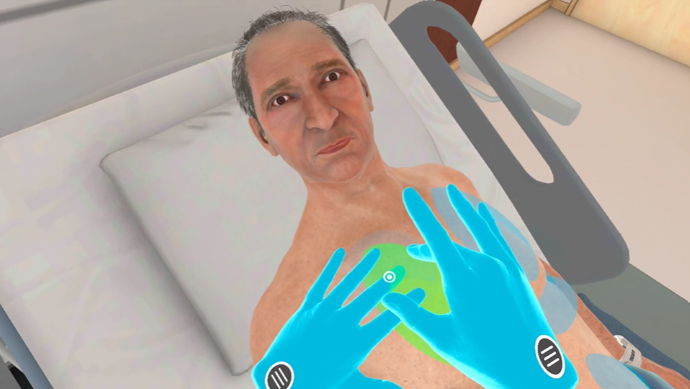
Enhanced Auscultation and Percussion Assessment
Explore UbiSim VR enhanced auscultation and new percussion assessment features built for nursing education
%20(2).png)
The UbiSim Difference: Built, Designed, and Implemented by Nurses
Every step of the UbiSim experience is led by nurses. Discover what nurse-led VR simulation means for your nursing program.
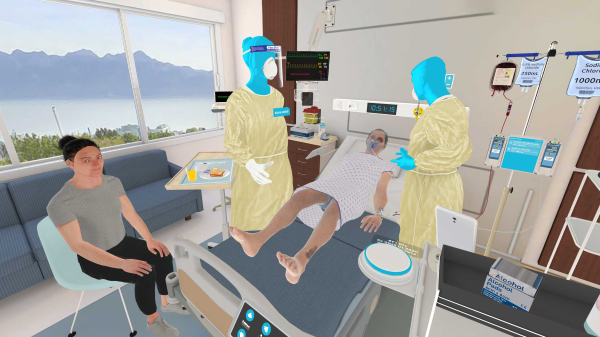
From Make-Up Hours to Mastery: VR for Clinical Judgment
Discover how VR simulation moves nursing programs from seat-time compliance to measurable clinical judgment, with evidence to back it up.