Preparing Practice-Ready Nurses: How the 2026 NCLEX-RN Updates Reinforce the Role of Immersive Learning
.jpg)
Table of Contents
Name of the heading 1
1- Start your table with the syntax {start-table}
2 - Add an H3 Heading to create a new column (this will be the column title)
3 - List cells as bullet points in a List element
4 - End your table with the syntax {end-table}
The 2026 NCLEX-RN Test Plan represents both stability and progress. For educators, it offers reassurance that the exam’s fundamental structure remains consistent, but it also signals important refinements in what counts as “practice-ready”. As nursing programs align curriculum and assessment strategies to this updated plan, virtual reality (VR) simulation stands out as a powerful ally in bridging NCLEX success and clinical competence.
Understanding the 2026 NCLEX-RN Update
The blueprint looks familiar: the Client Needs categories, weighting, Clinical Judgment Measurement Model (CJMM), and Integrated Processes all remain intact. Students will still navigate the same six-step CJMM framework: Recognize cues, Analyze cues, Prioritize hypotheses, Generate solutions, Take action, and Evaluate outcomes, and educators can continue designing experiences that follow these cognitive steps.
The most visible structural edit is the renaming of “Safety and Infection Control” to “Safety and Infection Prevention and Control,” which emphasizes proactive safety culture rather than reactive correction.
However, the most meaningful changes are not structural; they are embedded within the Activity Statements, which serve as the operational definition of clinical readiness. This is where the NCLEX defines new expectations for entry-level practice.
New Focus Areas in Practice
These refinements signal a shift from performing tasks to embodying professional practice. Three expectations now sit at the center of entry-level nursing:
- Care must be equitable
- Safety must be preventative
- Privacy must be intentional
Together, these updates reflect a deeper expectation: graduates must deliver care that is not only technically competent, but equitable, anticipatory, and responsive to the realities of modern healthcare.
From Recall to Judgment
Since the Next Generation NCLEX launched in 2023, the exam’s focus has been shifting from recalling facts to applying judgment. The 2026 update solidifies that trajectory. Success now depends on how well students connect assessment data, environmental cues, and patient needs to sound decisions in real time
For nurse educators, this demands a teaching model rooted in competency-based education. Students must move from passive knowledge acquisition to immersive, applied clinical reasoning across diverse and realistic scenarios.

Download Report: Gaps Between Nursing Education and Employer Expectations
See the study that reveals how AI is changing hospital hiring expectations for new nurses.
Simulation as the Bridge to Competency
Simulation remains one of the most effective ways to practice the NCLEX CJMM in a safe, structured environment. More importantly, simulation is becoming one of the most controlled and reliable ways to assess clinical judgment in action. High-fidelity scenarios let learners apply reasoning, prioritize interventions, and practice communication without risk to patients.
This is also where repetition and remediation become impactful. When students struggle with prioritization, delegation, safety, or clinical judgment, simulation gives them a structured way to pause, reflect, and repeat. Rather than functioning as a one-time correction, remediation becomes a deliberate learning cycle that strengthens judgment and builds confidence over time.
What makes simulation especially powerful for NCLEX preparation is that competency development is scaffolded. A fundamental learner organizing care for a stable patient looks very different from an advanced learner managing a rapidly deteriorating patient while escalating care, prioritizing interventions, administering medications, and communicating with family members. The NCLEX competencies are revisited throughout the curriculum with increasing complexity, and effective simulation design mirrors that progression.
With the new test plan’s activity statements, simulation can now more precisely reflect NCLEX expectations. For example:
- A Safety and Infection Prevention scenario might involve identifying and correcting infection control or environmental safety risks, emphasizing prevention of harm to the client and healthcare team.
- A Psychosocial Integrity scenario might require providing unbiased, patient-centered care by respecting identity, culture, and expressed needs.
- A Basic Care and Comfort scenario can explicitly assess maintaining client dignity and privacy during personal care, including communication, and limiting exposure.
Why Virtual Reality Matters
VR simulation builds on these advantages by enabling experiences that are difficult to standardize or reproduce in traditional settings. Research continues to show that repeated simulation strengthens competence, confidence, and clinical reasoning, which makes it especially useful for remediation.
Within a virtual environment, educators can deliver scaffolded experiences that move from simple to complex, giving learners consistent, high-quality exposure to scenarios at the right level. This includes high-risk scenarios involving diverse patient populations that may not reliably occur in clinical or lab settings.
The UbiSim scenario catalog reflects all three areas of focus from the 2026 NCLEX updates, and every scenario is mapped across the full NCLEX framework, including CJMM steps, Client Needs categories, Integrated Processes, and individual Activity Statements. That mapping is visible to educators directly inside the platform, allowing faculty to intentionally align simulation with curriculum goals, remediation plans, and NCLEX preparation.
A few examples of how the 2026 Activity Statement updates appear in practice:
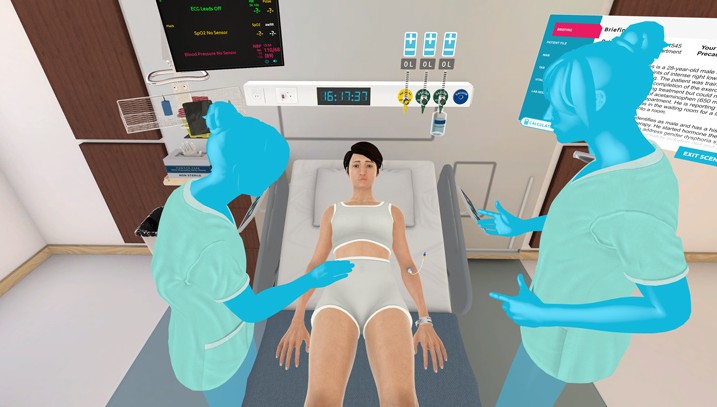
Equitable care: The Skylar Holmes scenario places learners in the care of a transgender man undergoing gender-affirming hormone therapy who is experiencing abdominal pain from an ovarian cyst rupture. The scenario emphasizes therapeutic communication, inclusive language, appropriate history-taking, and culturally responsive care. It helps learners recognize how bias, stigma, and limited access to inclusive healthcare can directly impact health outcomes.
The Jeremy Anderson scenario takes a complementary angle, following an immunocompromised patient experiencing an endemic illness and depression. Learners explore how mental health, housing instability, discrimination, and social determinants of health impact patient outcomes and access to care, all while practicing compassionate, stigma-free nursing.
Intentional privacy: Across the catalog, and especially in procedures like indwelling catheter insertion, learners practice preserving privacy, maintaining respectful boundaries, and delivering patient-centered care. Dignity and privacy are treated as clinical competencies, not afterthoughts.
Proactive safety: Infection prevention, hand hygiene, PPE use, and proactive safety behaviors are embedded throughout every UbiSim scenario, because they are foundational to safe nursing practice, not a standalone module.
VR is especially valuable for remediation because it offers repeatable, low-risk practice with immediate feedback. A student who misses cues, struggles with prioritization, or hesitates in communication can revisit the same scenario until both performance and confidence improve. That repetition is what turns developing skills into consistent, safe clinical practice.
Bridging NCLEX Success and Readiness
The message from the 2026 NCLEX-RN Test Plan is clear: nursing competence is about judgment, equity, and safety. Simulation, especially VR-enhanced simulation, translates these expectations into actionable learning.
When immersive education mirrors the updated Activity Statements, graduates do not just pass the exam; they embody the competencies it measures. Preparing practice-ready nurses means teaching beyond the test, using tools that foster reasoning, empathy, and confidence in complex clinical environments.
Give your learners hands-on clinical simulation training that builds confidence, improves decision-making, and prepares them for real-world patient care in a safe, scalable virtual environment.
FAQs
Heading 1
Heading 2
Heading 3
Heading 4
Heading 5
Heading 6
Lorem ipsum dolor sit amet, consectetur adipiscing elit, sed do eiusmod tempor incididunt ut labore et dolore magna aliqua. Ut enim ad minim veniam, quis nostrud exercitation ullamco laboris nisi ut aliquip ex ea commodo consequat. Duis aute irure dolor in reprehenderit in voluptate velit esse cillum dolore eu fugiat nulla pariatur.
Block quote
Ordered list
- Item 1
- Item 2
- Item 3
Unordered list
- Item A
- Item B
- Item C
Bold text
Emphasis
Superscript
Subscript
The 2026 update preserves the core structure: Client Needs categories, the Clinical Judgment Measurement Model (CJMM), and Integrated Processes all remain intact. The most notable changes are a rename of "Safety and Infection Control" to "Safety and Infection Prevention and Control," and meaningful updates to the Activity Statements, which now place greater emphasis on equitable care, proactive safety, and intentional privacy practices.
VR scenarios can be purpose-built to mirror the updated Activity Statements directly, from infection prevention and environmental safety to patient dignity and culturally responsive care. Because VR allows for repeatable, controlled scenarios with real-time performance data, educators can coach specific CJMM steps and ensure consistent exposure to situations that may not reliably occur in clinical placements.
When students struggle with prioritization, delegation, or clinical judgment, simulation creates a structured cycle of practice, reflection, and repetition, rather than a one-time correction. VR enhances this by letting learners revisit the same scenario until both performance and confidence improve, turning developing skills into consistent, safe clinical practice.


Christine Vogel is a clinical nurse, simulationist, and nurse educator who believes in the capacity of every nurse learner to realize their full potential by engaging in deliberate practice and choosing to start with the "Basic Assumption" that everyone is intelligent, capable, cares about doing their best, and wants to improve. As Lead Nurse Educator at UbiSim, Christine is actively engaged in designing, piloting, and evaluating evidence-based immersive VR simulations for nurse learners. In addition to her 25+ years in nursing, she has over a decade of experience in nursing academia where she developed, facilitated, and evaluated high-fidelity simulations in virtual reality as well as other modalities.
Explore more
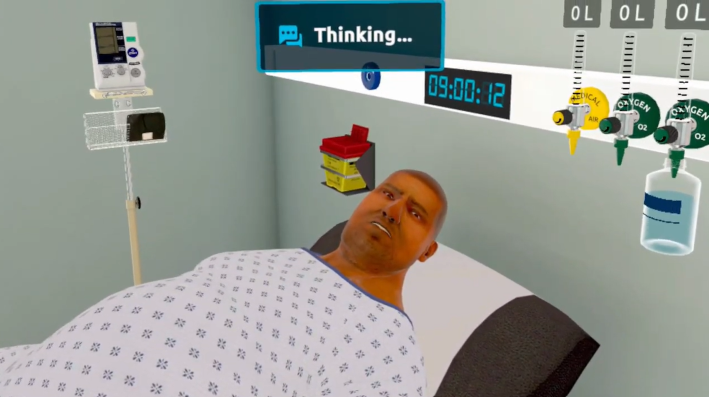
The Benefits of AI Patient Dialogue in VR Nursing Simulation
AI patient dialogue brings real conversation practice to VR nursing simulation, building learner confidence and empathy while helping programs scale smarter
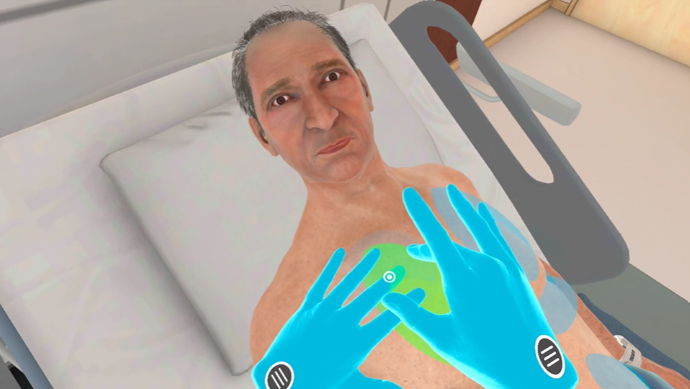
Enhanced Auscultation and Percussion Assessment
Explore UbiSim VR enhanced auscultation and new percussion assessment features built for nursing education

How Immersive VR Prepares Nurses for the Demands of Real Patient Care
Discover how immersive VR simulation builds clinical judgment and confidence in nurses using a real Med-Surg scenario as the guide.