Table of Contents
Name of the heading 1
1- Start your table with the syntax {start-table}
2 - Add an H3 Heading to create a new column (this will be the column title)
3 - List cells as bullet points in a List element
4 - End your table with the syntax {end-table}
In healthcare education, "make-up hours" have long been a necessary workaround, an attempt to fill gaps caused by missed clinical time, limited placement availability, or unpredictable schedules. But what if we stopped thinking about replacement hours as a compromise, and instead saw them as an opportunity to enhance learning?
Virtual reality (VR) is making that shift possible.
For educators and administrators, the conversation is no longer just about compliance. It's about competency. And more specifically, about developing clinical judgment, the cornerstone of safe, effective patient care.
The Problem with "Make-Up Hours"
Traditional make-up hours often rely on passive or inconsistent experiences: case studies that lack real-time decision pressure, skills labs that isolate tasks from clinical context, and shadowing opportunities where exposure is entirely dependent on what happens to walk through the door that day. While these approaches can check a box, they don't always ensure that students are building the decision-making skills required in real clinical environments. Clinical judgment isn't learned through observation alone. It's developed through practice, reflection, and repetition in meaningful contexts.
Why Clinical Judgment Matters More Than Ever
Healthcare is increasingly complex, and new graduates are expected to meet that complexity from day one. They need to recognize subtle changes in patient conditions, prioritize care under pressure, make timely evidence-based decisions, and communicate effectively across interdisciplinary teams. These aren't skills that come from memorization. They require situational awareness and experience that can only be built through practice.
And that's where VR stands apart.
From Hours to Outcomes: What VR Changes
Virtual reality shifts the focus from time spent to skills gained. Knowing VR supports the development of nursing competence by enhancing confidence and strengthening clinical decision-making skills, we can shift our attention from clinical hours to outcomes.
Instead of asking: "How many hours did the student complete?"
We can ask: "What clinical decisions did the student demonstrate, and how well did they perform?"
1. Immersive, Repeatable Scenarios
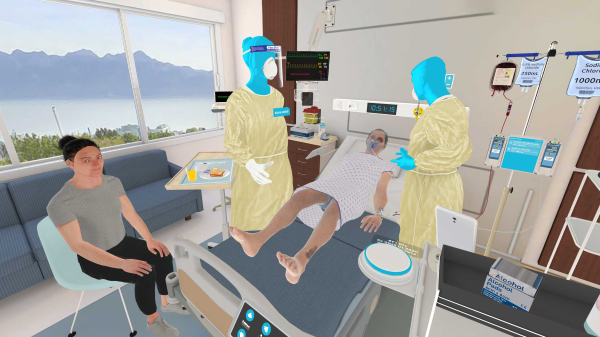
Because learners can repeat scenarios and receive immediate feedback, VR supports deliberate practice, a teaching strategy known to improve skill acquisition and clinical reasoning. VR places students inside realistic patient encounters where they must assess symptoms, interpret data, and make decisions in real time. Unlike clinical placements, these experiences can be repeated until mastery is achieved without risking patient safety.
2. Safe Practice for High-Stakes Situations
Virtual reality-based learning encourages active participation, improves memory retention, and helps build skills within a secure and controlled setting. Certain scenarios, like rapid deterioration, rare conditions, or emergency interventions, are difficult to guarantee in traditional settings. VR ensures that every learner encounters critical situations, practices appropriate responses, and builds confidence before entering real clinical environments.
3. Immediate Feedback and Reflection
Research shows that VR simulation can significantly improve nursing students' theoretical knowledge, practical skills, and overall satisfaction with learning compared with traditional teaching approaches. Clinical judgment improves when students can reflect on their decisions. VR platforms provide real-time cues and consequences, post-scenario debriefing tools, and performance insights tied to learning objectives, transforming each session into a guided learning loop, not just a one-time experience.
4. Standardized Learning Experiences
Evidence suggests that high-quality simulation can produce educational outcomes comparable to traditional clinical experiences, while providing more focused and efficient learning opportunities. Not all clinical placements are created equal. VR ensures that every student faces the same core scenarios, is evaluated using consistent criteria, and has equal access to high-quality experiences, supporting program consistency and accreditation readiness.

Download Report: The Nurse Readiness Crisis
Discover what nursing students say they need to be patient-ready.
Reframing "Make-Up" as "Mastery"
For many programs, simulation has long been a valuable strategy for bridging gaps in clinical experiences. In one study comparing traditional simulation with immersive VR scenarios, 95% of students actively participated in VR experiences compared with only 15% in traditional simulation. Rather than viewing VR as a substitute for missed hours, forward-thinking programs are using it to strengthen clinical judgment, fill experiential gaps with intentional design, and track competency development over time. This is a critical shift from seat time to skill mastery.
How Does VR Support Nursing Faculty and Program Goals?
Incorporating virtual reality simulation into nursing education can enhance student learning outcomes while advancing the nursing profession as a leader in healthcare technology and innovation. For educators, VR doesn't replace teaching. It enhances it. VR provides structured scenarios aligned with curriculum goals, tools for guided debrief and discussion, and data to support student evaluation and remediation. For administrators, it offers scalable solutions to placement shortages, measurable learning outcomes, and increased program resilience and flexibility.
How is VR Changing the Future of Clinical Education?
Studies show that VR simulations help improve students' confidence, clinical decision-making, and commuication skills while providing realistic and engaging learning experiences. Healthcare education is evolving, and so are expectations. Students need more than exposure. They need practice, feedback, and confidence in their clinical judgment. Virtual reality enables programs to move beyond simply making up lost time and towards ensuring that every learner is truly prepared.
Final Thought
"Make-up hours" solve a scheduling problem.
VR solves a learning problem.
By embracing immersive technology, educators and administrators can ensure that every hour, whether in the clinic or in simulation, moves students closer to what matters most: competent, confident clinical decision-making.
Give your learners hands-on clinical simulation training that builds confidence, improves decision-making, and prepares them for real-world patient care in a safe, scalable virtual environment.
FAQs
Heading 1
Heading 2
Heading 3
Heading 4
Heading 5
Heading 6
Lorem ipsum dolor sit amet, consectetur adipiscing elit, sed do eiusmod tempor incididunt ut labore et dolore magna aliqua. Ut enim ad minim veniam, quis nostrud exercitation ullamco laboris nisi ut aliquip ex ea commodo consequat. Duis aute irure dolor in reprehenderit in voluptate velit esse cillum dolore eu fugiat nulla pariatur.
Block quote
Ordered list
- Item 1
- Item 2
- Item 3
Unordered list
- Item A
- Item B
- Item C
Bold text
Emphasis
Superscript
Subscript
Regulatory guidance varies by state and accrediting body, but the research is clear: high-quality VR simulation can produce learning outcomes comparable to traditional clinical placements, and in some areas, exceed them. A 2022 Elsevier white paper found that virtual patient simulation can be used in substitution for traditional clinical hours in undergraduate nursing education when designed intentionally. Many programs are using VR not as a last resort, but as a deliberate part of their curriculum, pairing immersive scenarios with faculty-led debriefing to ensure students aren't just logging time, but demonstrating competency.
Clinical judgment requires more than knowing what to do. It requires knowing when, why, and in what order, often under pressure and with incomplete information. VR simulation places students inside realistic, unfolding patient scenarios where they have to assess, prioritize, and act in real time. Unlike task trainers or case studies, VR can simulate rapid patient deterioration, competing care demands, and team communication, the exact conditions where clinical judgment is actually tested. The immediacy of feedback and the ability to repeat scenarios until mastery is reached makes VR uniquely suited to developing this skill.
Look beyond the technology and evaluate the learning design. The most effective VR platforms for nursing education include scenarios that are grounded in evidence-based practice, aligned to accreditation competencies (like those from ACEN or CCNE), and built with debriefing tools that support guided reflection, not just scenario completion. You should also ask how the platform tracks and reports student performance data, whether scenarios can be customized to your curriculum, and what implementation support is available for faculty who are new to simulation pedagogy. The goal isn't a polished demo. It is a platform your educators can actually teach with.


Debra "Debbie" Loop, DNP, RN, CNE, CHSE, is a Nurse Educator at UbiSim with 37+ years in nursing education and 18 years specializing in simulation. She creates immersive VR scenarios that equip faculty with innovative teaching tools and empower learners to think critically, observe carefully, and practice safely.
Explore more
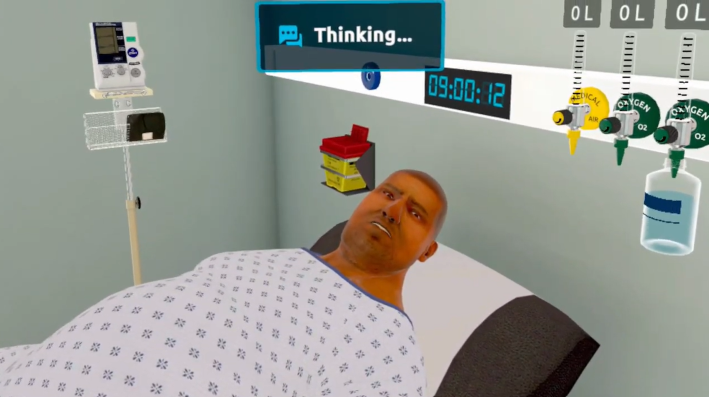
The Benefits of AI Patient Dialogue in VR Nursing Simulation
AI patient dialogue brings real conversation practice to VR nursing simulation, building learner confidence and empathy while helping programs scale smarter
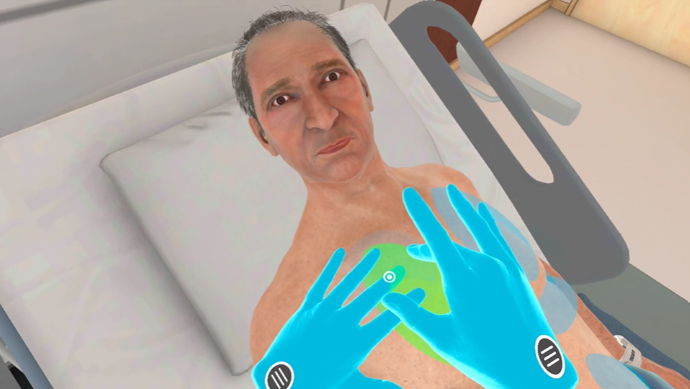
Enhanced Auscultation and Percussion Assessment
Explore UbiSim VR enhanced auscultation and new percussion assessment features built for nursing education

How Immersive VR Prepares Nurses for the Demands of Real Patient Care
Discover how immersive VR simulation builds clinical judgment and confidence in nurses using a real Med-Surg scenario as the guide.