How to Write Grant Applications That Actually Get Funded for VR Nursing Education

Table of Contents
Name of the heading 1
Nursing programs across the country are under intense pressure. Clinical sites are saturated. Faculty capacity is stretched. And the pipeline of graduates the healthcare workforce desperately needs keeps falling short of demand. The U.S. Bureau of Labor Statistics projects more than 193,000 registered nurse openings annually through 2032.
Funding exists to address this. Federal education grants, state workforce development dollars, philanthropic health initiatives, and regional workforce boards are all investing in nursing education capacity. The bottleneck isn't the money. It's the language.
Grant reviewers read dozens of applications. They can spot technology-forward framing and dismiss it in seconds. The programs that win funding are the ones that know how to speak the funder's language: workforce outcomes, regional impact, measurable accountability.
1- Start your table with the syntax {start-table}
2 - Add an H3 Heading to create a new column (this will be the column title)
3 - List cells as bullet points in a List element
4 - End your table with the syntax {end-table}
The Problem With How Most Programs Frame VR
Here's a scenario that plays out constantly in grant applications:
A nursing program wants to implement VR simulation. They've done their research on UbiSim. They know the clinical value. They sit down to write the budget justification and they write something like:
"We are requesting funding for 15 VR headsets and corresponding software, which will provide our students with an immersive experience using cutting-edge technology."
Risky.
Not because VR isn't valuable or the program doesn't have a legitimate need. But because that language positions VR as an educational technology purchase, not as workforce infrastructure.
The same initiative, reframed:
"This initiative will enable us to increase our annual training capacity by 25%, allowing us to graduate an additional 25 nurses per year to support regional workforce shortages, without relying on already constrained clinical placement sites."
That's the version that gets funded. The technology is the same. The outcomes are the same. The difference is entirely in how the work is positioned.
What Grant Reviewers Are Actually Looking For
Workforce and education funders consistently prioritize four themes, regardless of whether you're applying to a federal education grant, a state workforce board, or a philanthropic health system partnership:
{start-table}
Grant Priority
- Capacity Expansion
- Practice Readiness
- Access & Opportunity
- Workforce Stability
How VR Supports It
- Enables training without additional sites
- Provides structured clinical judgment development
- Supports flexible scheduling and rural learners
- Improves graduate readiness, reducing employer onboarding
Language Focus for Applications
- "Increase annual graduates by [X]," "expand enrollment," "reduce clinical placement burden,"
- "NCSBN-aligned scenarios," "faculty-guided debriefing," "competency-based assessment"
- "Equitable access," "non-traditional students," "geographic barriers reduced"
- "Transition-to-practice support," "reduced training burden," "retention in high-need areas"
{end-table}
VR simulation addresses all four, but only if your application says so, explicitly, with the right metrics and the right framing.
The Language Gap Is a Solvable Problem
Most program leaders and grant writers know their work deeply. They understand clinical judgment development. They know their students. They know their regional workforce gaps. What’s often hardest to find is ready-made language that bridges that expertise to what reviewers expect to see on the page.
That means every application requires starting from scratch: researching the funder's priorities, translating your program's outcomes into workforce terms, writing budget justifications that hold up to scrutiny, and building evaluation frameworks that demonstrate accountability.
It's time-consuming work and under grant deadlines, even the strongest programs are stretched thin.
A Faster Path to Fundable Language
That’s why UbiSim built the Grant-Ready Toolkit.
It's a comprehensive collection of modular, adaptable grant language including budget justifications, outcome statements, evaluation frameworks, and funder-specific response templates, designed to be lifted, customized with your program's data, and submitted with confidence.
Inside the toolkit, you'll find:
- Plug-and-play budget language for equipment, training, onboarding, and sustainability written to position VR as workforce infrastructure, not a tech purchase
- Outcome language tied to the workforce metrics funders actually measure: capacity expansion, learner readiness, workforce stability, and access
- A complete logic model template that walks from inputs through long-term workforce impact across a three-year evaluation horizon
- Adaptation guidance by grant type including federal education, state workforce development, workforce boards, and philanthropic partnerships each with distinct priorities
- A do's and don'ts language guide that flags the specific phrases that undermine applications (and what to say instead)
- Common grant prompts with ready-to-use VR-specific responses for questions on access, sustainability, employer engagement, and alignment to national standards
Who Should Use this Toolkit
The toolkit was built for:
- Grant writers at public colleges and universities who need proven language quickly
- Nursing program directors developing workforce initiatives and managing multiple applications simultaneously
- State and regional workforce development leaders building multi-institution proposals
- Healthcare-education partnership coordinators navigating philanthropic and health system funding
If you're accountable for both winning grants and defending outcomes to multiple stakeholders, this toolkit was designed for you.
The Stakes Are High Enough to Get the Language Right
Nursing workforce funding is competitive. Programs with strong, workforce-focused applications advance. The Grant-Ready Toolkit won’t write your grant for you, but it will put your best language forward, so your application reflects the strength of the work you are doing.

FAQs
Heading 1
Heading 2
Heading 3
Heading 4
Heading 5
Heading 6
Lorem ipsum dolor sit amet, consectetur adipiscing elit, sed do eiusmod tempor incididunt ut labore et dolore magna aliqua. Ut enim ad minim veniam, quis nostrud exercitation ullamco laboris nisi ut aliquip ex ea commodo consequat. Duis aute irure dolor in reprehenderit in voluptate velit esse cillum dolore eu fugiat nulla pariatur.
Block quote
Ordered list
- Item 1
- Item 2
- Item 3
Unordered list
- Item A
- Item B
- Item C
Bold text
Emphasis
Superscript
Subscript
The toolkit is designed for grant writers at public colleges and universities, nursing program directors managing multiple funding applications, state and regional workforce development leaders building multi-institution proposals, and healthcare-education partnership coordinators navigating philanthropic and health system funding. If you're responsible for securing public or philanthropic funding to expand nursing education capacity while operating under tight deadlines and high accountability, this toolkit provides the modular language you need.
Technology-focused language emphasizes features and equipment: "We are requesting funding for 15 VR headsets to provide an immersive experience." Workforce-focused language leads with measurable outcomes: "This initiative will increase our annual training capacity by 25%, graduating an additional 25 nurses per year to address regional workforce shortages." Grant reviewers prioritize applications that demonstrate capacity expansion, practice readiness, access for underserved populations, and workforce stability.
Yes. The toolkit includes grant type adaptation guidance specifically designed for state workforce development grants, federal education grants, workforce board and regional initiatives, and philanthropic and health system partnerships. Each grant type prioritizes different language, metrics, and outcomes. The toolkit provides specific examples and adaptation instructions so you can customize the modular language blocks to match your funder's priorities and evaluation criteria.


Tracy's work sits at the intersection of clinical learning and product strategy helping the field understand not just what VR simulation can do, but why it matters right now. She is passionate about connecting innovation with real-world impact and championing nurses at the forefront of one of healthcare's most critical transformations.
Explore more
VR Is Nursing Workforce Infrastructure, Not Just Educational Technology
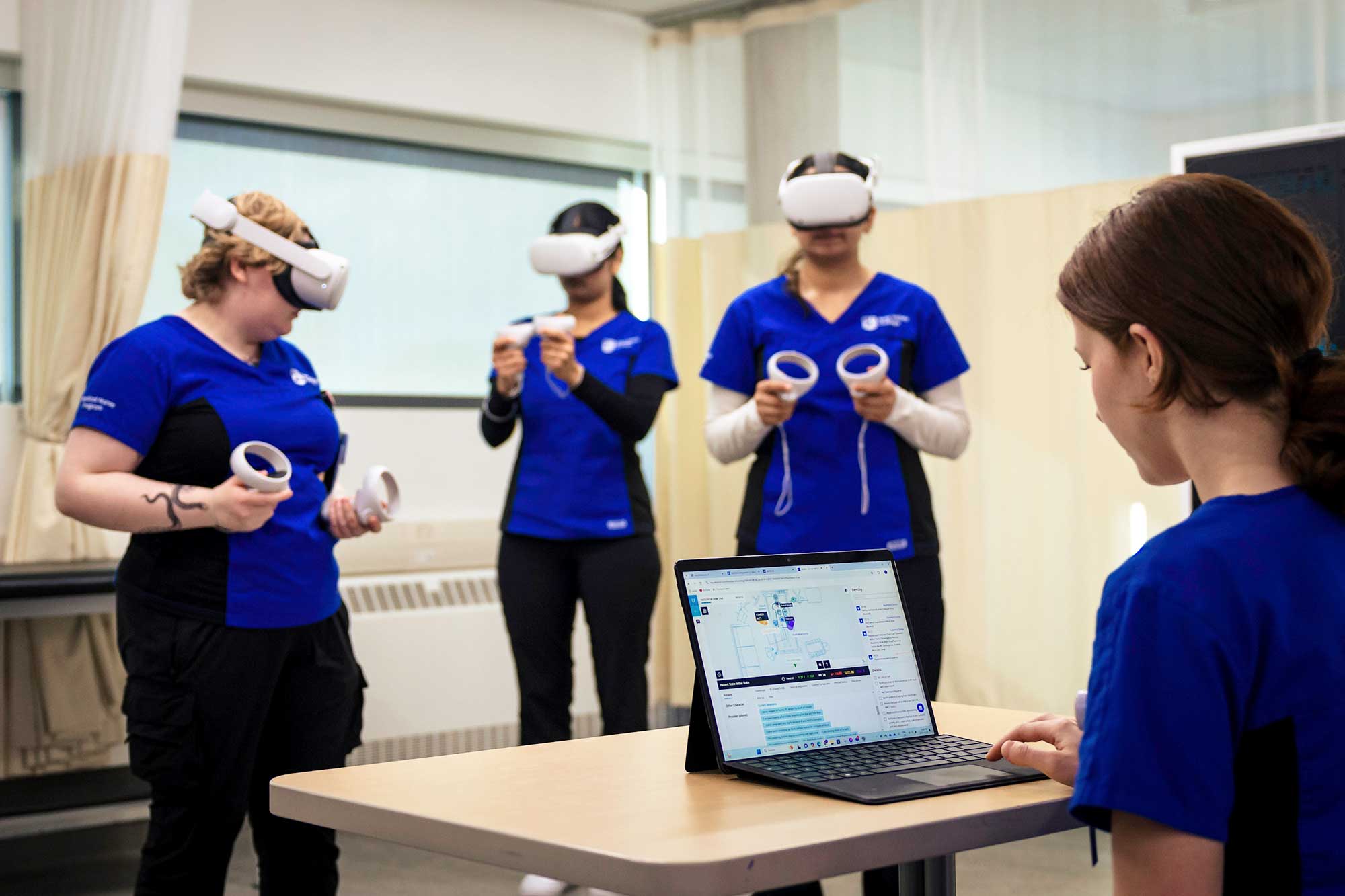
Here's what it looks like when programs invest in VR as workforce infrastructure and expand enrollment by 25–50%.
How to Write Grant Applications That Actually Get Funded for VR Nursing Education
Learn how to position VR as workforce infrastructure with ready-to-use grant language for nursing education funding.
.jpg)
Step Into VR Simulation: A Nurse-Led Guide to Implementation
A step-by-step nurse-led guide to implementing VR in nursing education, with practical strategies, faculty tips, and interactive workbook activities.

