Humanizing Clinical Technology through an Artificial Wisdom Framework at Hesston College
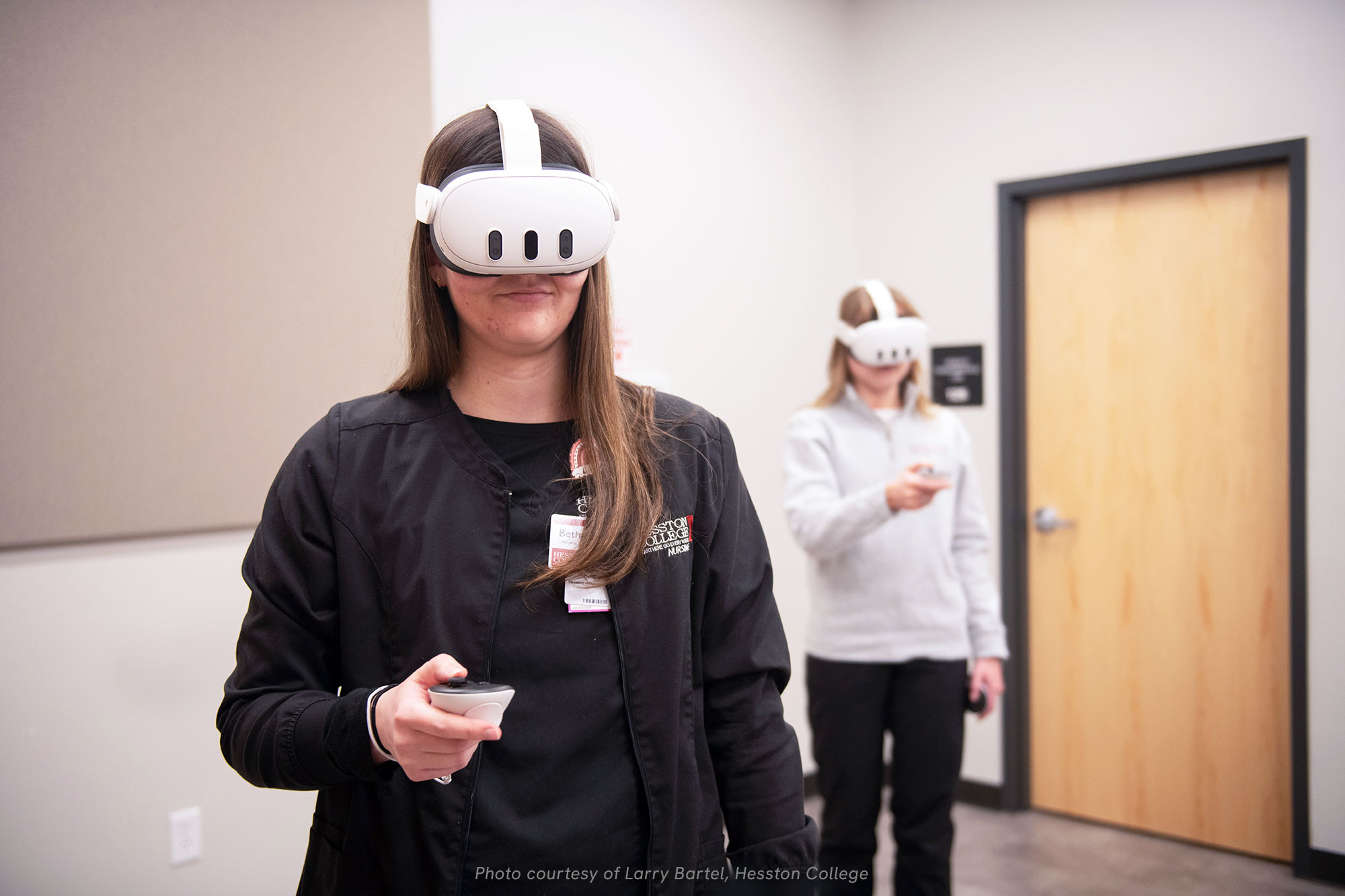
Table of Contents
Name of the heading 1
What does it take to graduate a nurse who can save a life and hold a patient's hand at the same time? Gregg Schroeder, Director of Nursing Education at Hesston College, has spent more than 30 years trying to answer that question. In this piece, he shares the framework his team built, and what happened when they stopped treating simulation as a checklist and started treating it as a formation tool.
Gregg Schroeder, MSN, APRN-CNS, is Director of Nursing Education at Hesston College in Kansas, where he has taught since 1992. As a clinical nurse specialist and former intensive care nurse with more than three decades of bedside and educator experience, Gregg brings real-world patient care into the simulation lab. He has spent his career helping students move from classroom concepts to confident clinical practice. He teaches holistic assessment, pharmacology, and evidence-based practice, and is known for building immersive simulation experiences that form nurses who think critically and care deeply.



"We are seeing fewer 'Action-Only' or 'Reflection-Only' graduates and more 'Integrated Clinicians' who can act decisively while preserving the dignity of those in their care."
1- Start your table with the syntax {start-table}
2 - Add an H3 Heading to create a new column (this will be the column title)
3 - List cells as bullet points in a List element
4 - End your table with the syntax {end-table}
Key takeaways
- High-fidelity simulation and VR/AI serve distinct, complementary roles in nursing formation, neither alone produces a complete clinician.
- The “Artificial Wisdom” framework integrates technical competence with human-centered perception, aligned with AACN Essentials (2021).
- Debriefing is the irreplaceable bridge. Without guided reflection, even the best simulation is just an activity.
The Challenge: The Risk of Asymmetrical Formation
In recent years, like many of you, I have watched the rapid expansion of educational technology with both excitement and a growing sense of caution. At our institution, we reached a crossroads where we had to ask a difficult question: Is our increasing reliance on high-fidelity simulation, virtual reality (VR), and artificial intelligence (AI) actually improving how our students think and care, or is it simply adding layers of technical complexity?
As nurse educators, we often face a hidden "tension of the heart." On one hand, we are tasked with producing graduates who are technically proficient and capable of decisive action. On the other, we are called to form professionals who remain deeply attentive to the human experience of illness. I began to notice a concerning trend that I’ve come to describe as "asymmetrical training."
Left to their own devices, our educational technologies were unintentionally creating two incomplete types of practitioners. First, there were the "Action-Only Clinicians"—students who were efficient, technically skilled, and fast decision-makers, but who risked becoming disconnected from the people they served. They could fix the ventilator, but forgot to look the patient in the eye. Conversely, we saw "Reflection-Only Clinicians"—students who were deeply empathetic and patient-centered but hesitated when a clinical crisis demanded immediate, competent action.
Furthermore, I realized that as our technologies became more sophisticated, the risk of the "person becoming secondary to the problem" increased. In a high-pressure simulation or a complex EHR training module, it is remarkably easy for a student to see a diagnosis instead of a patient, a task instead of a relationship, and an intervention instead of an experience. We realized that if we didn't change our approach, we were at risk of turning our students into highly skilled "task performers" rather than wise, compassionate nurses.
.png)
The Implementation: Integrating the "Artificial Wisdom" Framework
To bridge this gap, we implemented what we now call the Artificial Wisdom (AW) Framework. While AI focuses on processing information and generating responses, Artificial Wisdom emphasizes the integration of knowledge, experience, values, and relationships. Our goal shifted: we didn't just want to create nurses who know more; we wanted to form nurses who can wisely apply what they know.
We intentionally combined several technologies to support both technical competence and human understanding, aligning our curriculum with the AACN Essentials (2021) focus on professional identity formation and clinical judgment.
1. High-Fidelity Simulation for "Embodied Responsibility: We refined our use of high-fidelity simulation to focus on more than just checklists. We used it to foster "embodied responsibility"—that unique sense of ownership that occurs when a student must touch the patient, administer the medication, and live with the real-time consequences of their decisions.
2. Immersive VR and AI for Perspective-Taking: To balance the "action" of simulation, we introduced immersive technologies specifically designed to build empathy and communication skills. We implemented UbiSim for immersive VR clinical experiences and Bodyswaps for AI-driven communication and interpersonal skills development. These tools allow students to step into the patient’s shoes, navigating difficult conversations and exploring their own biases in a safe, repeatable environment.
3. EHR Training for Clinical Reasoning: We moved away from using platforms like Chartflow as mere documentation exercises. Instead, we integrated them as tools for clinical reasoning, ensuring that the electronic record served to highlight the patient’s story rather than reducing the human being to a series of data points.
4. Debriefing as the Essential Bridge: Perhaps the most critical change was our approach to debriefing. We recognized that while technology creates the experience, debriefing creates the meaning. We moved our debriefing sessions beyond the "Did you complete the task?" phase. We began asking: "Did the patient feel seen, heard, and cared for?" We used guided reflection to help students examine not just their clinical cues, but the patient’s vulnerability and the student’s own communication strengths and weaknesses.
{start-table}
Value Added (Intentional Design)
- Consistent exposure for every student
- High-risk situations practiced safely
- Failure acts as a powerful learning tool
The Critical Trap (Unintentional Design)
- Following checklists without thinking
- Focusing on task completion instead of reasoning
- Replacing simple methods at a higher cost without improving decisions
{end-table}
The Results: From Tasks to Transformation
The implementation of this integrated approach has led to several key observations in our student groups. We have seen a measurable shift from task-oriented thinking to human-centered connection.
One of the most striking results is how students now navigate clinical tension. In a recent scenario involving a patient in respiratory distress, I observed a student who, while efficiently calling for help and assessing the patient, took a brief moment to touch the patient’s hand and say, "I’m here, and we are going to help you breathe." In the debrief, the student didn't just talk about the heart rate; they talked about the fear they saw in the patient's eyes, the UbiSim avatar was programmed to look and sound fearful. This is the integration of action and understanding that we were striving for.
By using VR to explore communication barriers and social determinants of health, our students are asking themselves a new, vital question: "Do I create dignity, or diminish it?" We’ve found that when students understand how care feels—not just how it is delivered—they are far better prepared for the realities of modern practice.
Furthermore, the "Artificial Wisdom" approach has created a psychologically safe environment where mistakes are viewed as formative opportunities. Because the technology allows for repeated practice, students are developing a level of self-awareness and professional identity that was previously difficult to achieve consistently in traditional clinical placements. We are seeing fewer "Action-Only" or "Reflection-Only" graduates and more "Integrated Clinicians" who can act decisively while preserving the dignity of those in their care.
The Takeaway: Technology as an Instrument of Formation
For any colleague considering a similar expansion of technology, my primary takeaway is this: Technology is not neutral. It influences what our learners notice, how they respond, and ultimately, who they become.
If you are looking to implement these tools, I offer these suggestions:
- Avoid the "Novelty Trap": Do not let VR or AI become one-time novelties. They must be intentionally woven into the curriculum with specific learning goals that serve the student's professional formation.
- Prioritize the "Bridge": Never underestimate the power of the debrief. Without intentional, guided reflection, even the most expensive simulation is just an activity. Reflection is where the transformation happens.
- Use a Lens of Discernment: At Hesston College, we ask: "Does this technology help us love our neighbor well?" Regardless of your institutional background, find a value-based question that ensures the technology serves human flourishing rather than just efficiency.
The true measure of "value-added technology" is not how advanced the software is, but whether it helps develop nurses who combine sound clinical judgment with compassionate human care. Our goal is not to produce task performers, but to form professionals who act competently, think critically, and care deeply. When we design our simulations and VR experiences with this kind of intentionality, we don't just teach nursing—we shape the future of the profession.

Explore more
How Grande Ronde Hospital Built a Nurse Residency With a 93% Retention Rate
Grande Ronde Hospital paired VR simulation with a tailored preceptor model to reach a 93% nurse residency retention rate, and closed the new-grad readiness gap.

How Wyoming Scaled VR Clinical Simulation Statewide in Under a Year
See how UbiSim and CM&D scaled VR nursing education across 8 campuses in Wyoming, delivering nearly 3,000 VR simulation sessions and 98% faculty adoption.

The Blueprint for Scaling VR Nursing Simulation: Lessons From Maria College
Learn how Maria College used UbiSim to improve clinical readiness & student engagement across their nursing programs

