The Pilot-to-Program Playbook: How BCIT Made VR Simulation a BSN Standard
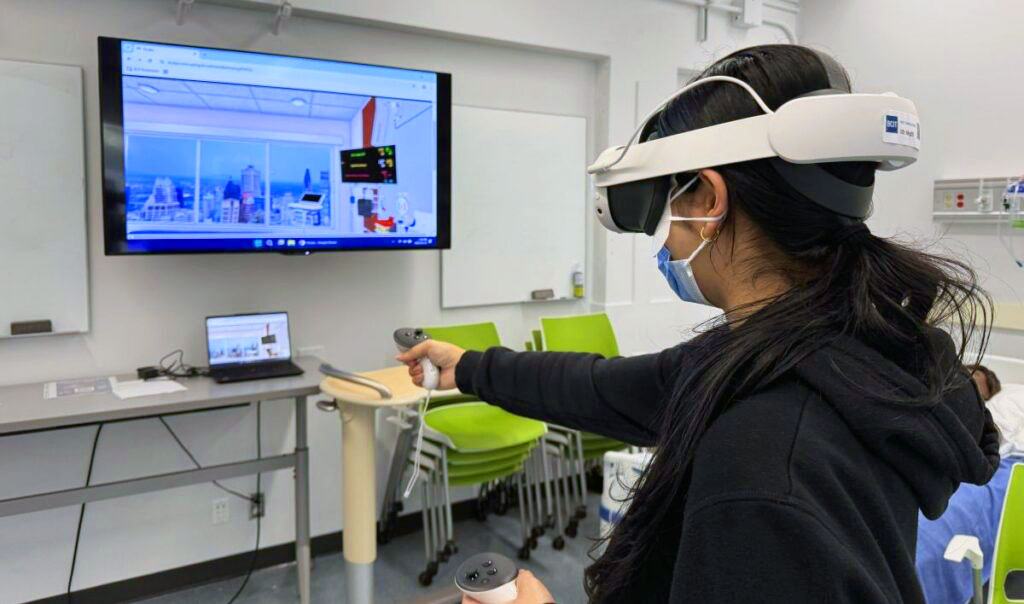
Table of Contents
Name of the heading 1
For nursing programs across Canada, securing specialty clinical placements has become increasingly difficult. Pediatric and obstetrics rotations are competitive, limited in scope, and often leave students without the consistent hands-on exposure they need. Robert Kim, working with BCIT's simulation team and BSN faculty, found a way. The approach they took, may be the most replicable part of the story.
This initiative with Robert Kim, Experiential Learning Coordinator for the BSN program at the British Columbia Institute of Technology (BCIT), was led in partnership with the BCIT School of Health Sciences Simulation Team and BSN program leadership and faculty.

%20Kim.jpg)

"Start as small as possible. Once that's adjunctive and optional, it's much less of a risk. And once people see it and experience it, the enthusiasm jumps quite a bit."
1- Start your table with the syntax {start-table}
2 - Add an H3 Heading to create a new column (this will be the column title)
3 - List cells as bullet points in a List element
4 - End your table with the syntax {end-table}
Key Takeaways
- Start before you're ready. Experience the technology before you use it to teach.
- Measure what matters from day one. Early data becomes the evidence you need later.
- The pilot is the playbook. Starting small isn't a workaround, it's the model.
Specialty Placements Are Shrinking, But BCIT Found Another Way
Like many Canadian nursing programs, BCIT was facing shrinking clinical placement opportunities in specialty areas, particularly obstetrics and pediatrics. "OB and peds clinical rotations are quite competitive between institutions," Robert explains. "And there are limiting factors to what students' scope of practice is within the clinical setting." They needed a way to give students consistent, meaningful exposure, and VR emerged as the answer.
How a Voluntary Lab Became a Formal Program
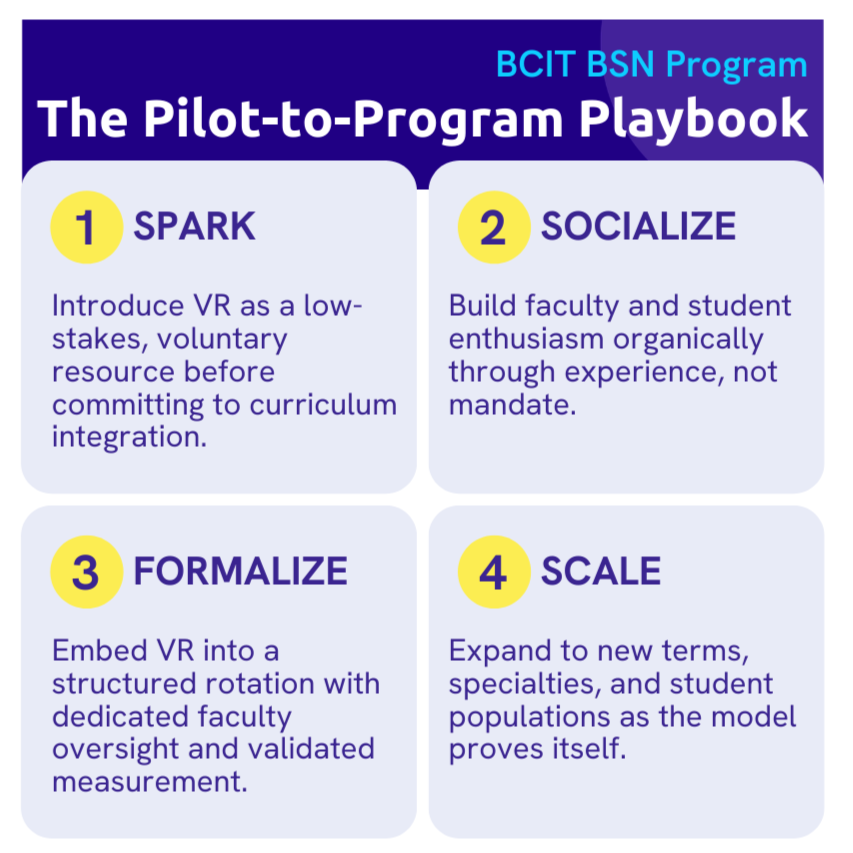
Rather than jumping straight into curriculum integration, the BCIT BSN Experiential Learning Team launched a voluntary open simulation lab to gauge interest and acclimatize both students and faculty to the technology. Faculty drop-in sessions spread enthusiasm by word of mouth, and informal survey data confirmed what they were seeing in the room: people wanted more. That low-stakes pilot gave them exactly what they needed to make the case for formal integration.
96 Students, One Structured Rotation, Real Results
Today, VR simulation using UbiSim is formally embedded into the Term 5 clinical alternative experience at BCIT, the term focused on obstetrics and pediatrics. Up to eight students come in each week for a four-hour session that includes technology orientation, OB and pediatric case scenarios, structured pre-briefing and debriefing, and time for students to chart and research their cases.
With up to 96 students in the current cohort, groups cycle through on a weekly rotation. Dedicated BSN Experiential Learning Team members oversee each session to maintain tight controls to ensure simulation best practices, and ensure data collection is consistent and reliable.
The four-hour structure is intentional. Students arrive prepared, having researched their cases in advance, so the time they spend in the headset is focused and purposeful. "Their recommendation is that students shouldn't be in VR sessions for longer than 12 to 15 minutes at a time," Robert notes. "So we try to make sure that time is as meaningful as possible."
How is BCIT building its evidence base for VR simulation?
BCIT BSN isn't just running a program; they're building an evidence base. The team is using validated instruments to assess both platform usability and how students perceive the learning efficacy of VR compared to traditional clinical experiences.
"If we find that students are reporting that the UbiSim cases have equivalent or greater efficacy than their perception of their clinical experience, that builds us a strong case, at least internally," Robert explains.
By January 2027, the team plans to present the full findings to BCIT's BSN faculty. In keeping with the program's commitment to collective governance, the decision to formally continue and expand VR will be made together. Based on the current trajectory, he's cautiously optimistic.
What surprised them most when students stepped into VR?
One of the most meaningful outcomes has been something that doesn't show up easily in survey data: how students show up differently in VR compared to traditional simulation.
Robert had anticipated that students might not take virtual patients seriously, that the pre-recorded voices and simulated environment would create distance. The opposite turned out to be true.
"Students were actually far more engaged with talking to the patients and the family members, much more directly," he says. "Once I got the students to be talking directly to the simulated family members and they would take it seriously and carry on the conversation, that was a really nice-to-see moment."
Perhaps even more striking was the reduction in performance anxiety. In traditional manikin-based simulations, a level of self-consciousness is common; students feel observed, evaluated, on the spot. In VR, that dynamic shifts.
"I got direct feedback from students saying that in a VR experience, they didn't feel like people were staring at them or like they needed to perform for an instructor," Robert shares. "Students feel a lot more calm and a lot more engaged."
And then there are the students stopping Robert in the hallway asking enthusiastically for more VR in their classes. "I've never had that with any of the other sims," he says. "I didn't have any students saying 'please add more high-fidelity manikin simulations.'" There is an energy to VR that sets it apart from anything else in the sim lab.
How is BCIT planning to scale VR across the rest of the program?
The roadmap for expansion is already taking shape. Mental health simulation is next, with faculty who previewed the UbiSim cases responding with strong enthusiasm. Focus of practice preceptor students are also potentially on the horizon, with a focus on practice-specific cases and, potentially, measuring readiness-to-practice confidence before and after VR exposure.
Longer-term, Robert sees the program moving toward earlier integration, introducing VR in foundational terms so that by the time students reach Term 5, onboarding is nearly effortless. "An average student finishes the tutorials in 15 minutes and then they're ready to go," he notes. "If we can introduce it in earlier terms, then in the simulation experiences we can focus more on the learning."
What advice does BCIT have for nursing programs starting their VR journey?
For Canadian nursing programs earlier in their VR journey, Robert offers two practical pieces of advice earned from experience.
First: find your champion. "You need someone who is willing to champion VR, someone who is super, super excited, because the learning curve is very steep and there's a lot to consider. But once that's in, then it's actually pretty easy."
Second: start small. "Start as small as possible. Start as a supportive, adjunctive option so it doesn't touch the existing curriculum or structure. Once people see it and experience it, the enthusiasm jumps quite a bit." Even a single Meta headset and a voluntary session is enough to start shifting perception.
The approach BCIT took, pilot first, validate, then integrate, is not just a story of one program's success. It may be a model worth replicating.

Explore more
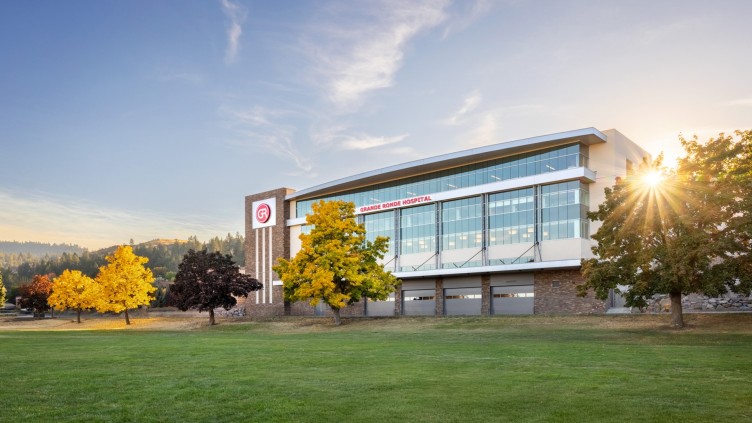
How Grande Ronde Hospital Built a Nurse Residency With a 93% Retention Rate
Grande Ronde Hospital paired VR simulation with a tailored preceptor model to reach a 93% nurse residency retention rate, and closed the new-grad readiness gap.

How Wyoming Scaled VR Clinical Simulation Statewide in Under a Year
See how UbiSim and CM&D scaled VR nursing education across 8 campuses in Wyoming, delivering nearly 3,000 VR simulation sessions and 98% faculty adoption.
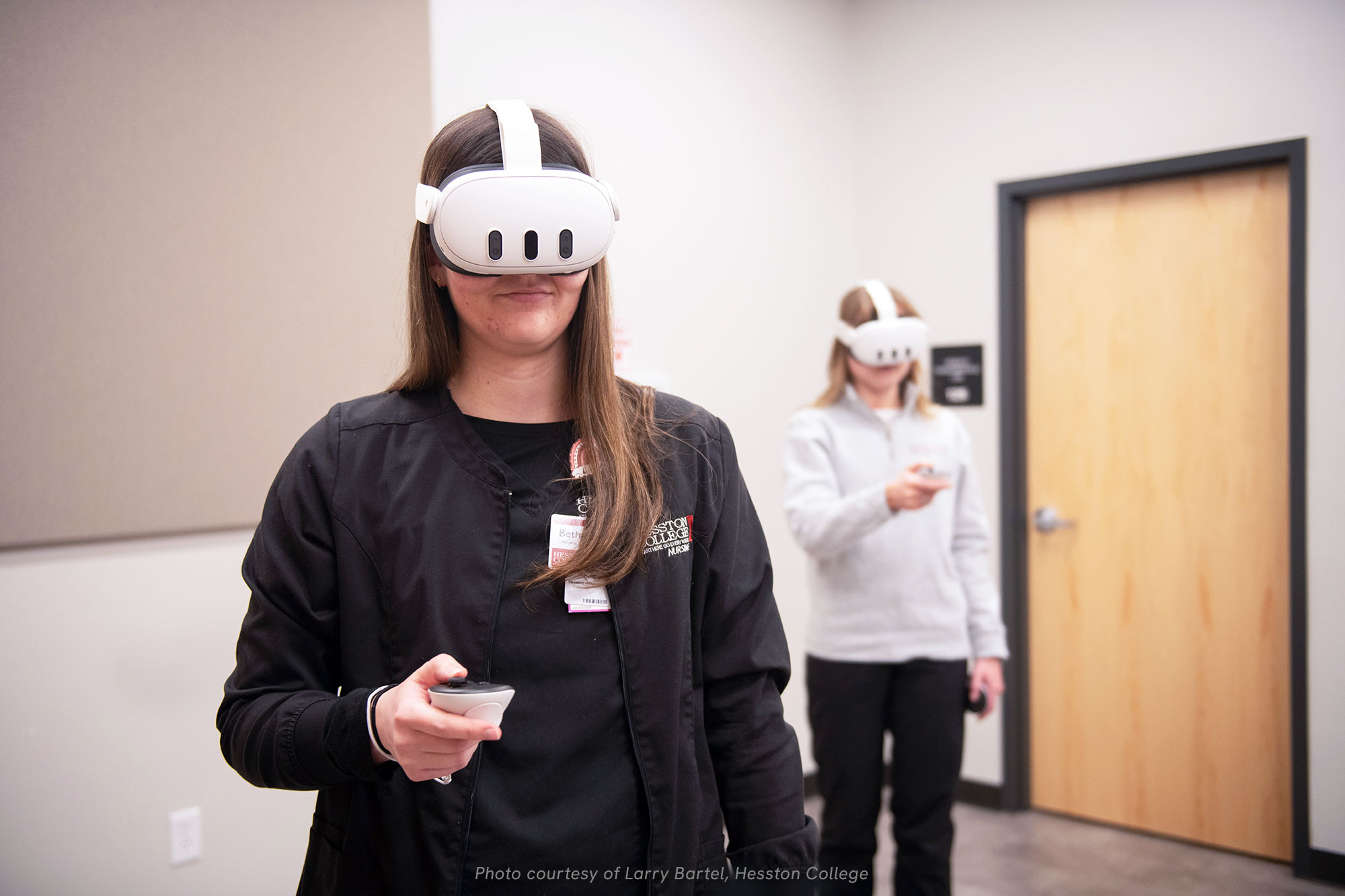
Humanizing Clinical Technology through an Artificial Wisdom Framework at Hesston College
Nurse educator Gregg Schroeder shares how high-fidelity simulation, UbiSim VR, and Artificial Wisdom framework forms confident and compassionate nurses.

