The Benefits of AI Patient Dialogue in VR Nursing Simulation
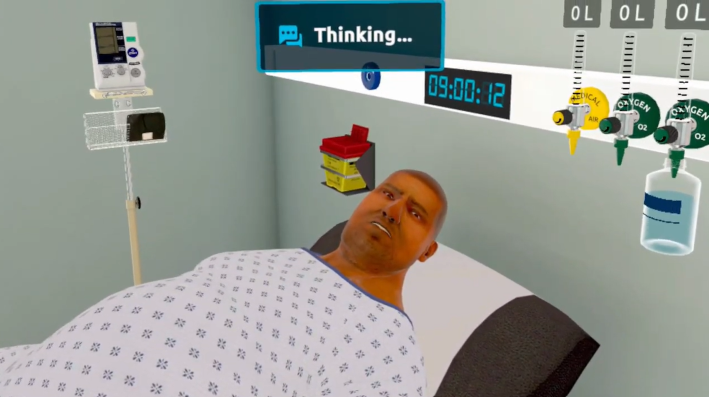
Table of Contents
Name of the heading 1
1- Start your table with the syntax {start-table}
2 - Add an H3 Heading to create a new column (this will be the column title)
3 - List cells as bullet points in a List element
4 - End your table with the syntax {end-table}
A nursing program can only grow as fast as its clinical placements, its facilitators, and its simulation lab hours allow. AI patient dialogue gives programs a new way to work within that constraint.
AI patient dialogue lets a virtual patient respond to a learner's own words in real time, rather than routing them through a fixed menu of scripted prompts. The learner asks an open-ended question, the patient responds in character, and the conversation unfolds the way a real clinical encounter would, with follow-up questions, uncertainty, and the occasional answer nobody expected.
Here's what that delivers.
The Benefits of AI Dialogue
Learners communicate with more confidence. Practicing with an AI patient instead of a fixed script raises both communication knowledge and confidence. In one study using an AI-enabled VR ward simulation, both measures rose significantly after a single round of training with an AI patient character (Liaw et al., 2023).
Empathy improves, and it lasts. AI-guided VR dialogue with real-time feedback produces a large jump in empathic communication right after training, and that gain holds up at follow-up (AI-enhanced VR empathy RCT). The practice builds a lasting skill, not just a memory of the exercise.
Learners stay engaged. Learners consistently describe AI patient interactions as interesting and attention-holding, even measured against scenarios they've run before and already know the answers to (Liaw et al., 2023).
Practice is available whenever a learner needs it. No waiting on a facilitator's open slot or a standardized patient actor's schedule. A learner can rehearse a difficult conversation, an unexpected answer, or a deteriorating patient as many times as it takes to feel ready, on their own time (AI-powered nursing simulation review).
Conversations feel like real ones. Learners aren't limited to a preset list of things to say, so they practice forming their own questions under pressure, a more transferable skill than recognizing the correct option on a list (GenAI-enhanced VR patient encounter study).
Stress goes down and satisfaction goes up. A pragmatic randomized trial found nursing learners using VR communication simulation reported lower clinical-practice stress and higher learning satisfaction than learners in the comparison group (pragmatic RCT, 2024).
There's also an operational case building here. AI patient dialogue can run 24/7, deliver the same standardized scenario to every learner, and repeat indefinitely without adding facilitator or standardized-patient hours for each additional session. That adds practice capacity per facilitator, not just per learner, which is the actual bottleneck most programs face. In one RCT, AI-generated communication scores lined up closely with educator ratings (AI-enhanced VR empathy RCT), pointing toward AI-enhanced analytics handling first-pass scoring so facilitators spend more time coaching and less time on rubrics. No study has yet directly measured facilitator hours saved or enrollment growth as an outcome, though the mechanism is sound and the early signals are strong.
How Programs Can Put AI-Driven Dialogue to Work
Picture a first-semester learner preparing for a Fundamentals clinical rotation, working up to a difficult conversation like a confused, anxious patient resisting a vital signs check. With AI patient dialogue, that learner runs the scenario independently, asks their own questions, gets an unscripted response, and repeats it until the conversation feels natural, before ever stepping into a real clinical setting. The facilitator's time shifts from running the scenario to reviewing the transcript and coaching on the judgment calls that mattered.
That shows up across the pressure points programs are feeling right now: facilitators spend more time coaching and less time on scenario logistics, standardized scenarios extend consistent practice across cohorts and campuses without adding facilitator hours for each one, and scenarios built around the NCSBN Clinical Judgment Measurement Model give learners structured reps at the exact skills the NCLEX Test Plan and AACN Essentials measure. Practice capacity is no longer capped by facilitator or placement availability, which gives programs room to grow enrollment without straining the simulation lab to do it.
Where Solo Mode Fits
Clinical placement slots are shrinking, new graduates are entering health systems without standardized preparation, and the learners who need the most practice often have the least access to it. Solo Mode is built to close that gap.
Solo Mode gives learners independent, standardized practice built on AI patient dialogue: built and reviewed by nurses, aligned to AACN Essentials, the NCLEX Test Plan, and the NCSBN Clinical Judgment Measurement Model. AI facilitates the dialogue and generates the performance report, so educators focus on the coaching conversation. Built for programs, not just individual learners, Solo Mode scales across cohorts and campuses with standardized scenarios and automated reporting.
Solo Mode and facilitated simulation are two modalities for two different learning moments: Solo Mode for independent practice and remediation at scale, facilitated simulation for teamwork and high-acuity scenarios with real-time coaching.

Give your learners hands-on clinical simulation training that builds confidence, improves decision-making, and prepares them for real-world patient care in a safe, scalable virtual environment.
FAQs
Heading 1
Heading 2
Heading 3
Heading 4
Heading 5
Heading 6
Lorem ipsum dolor sit amet, consectetur adipiscing elit, sed do eiusmod tempor incididunt ut labore et dolore magna aliqua. Ut enim ad minim veniam, quis nostrud exercitation ullamco laboris nisi ut aliquip ex ea commodo consequat. Duis aute irure dolor in reprehenderit in voluptate velit esse cillum dolore eu fugiat nulla pariatur.
Block quote
Ordered list
- Item 1
- Item 2
- Item 3
Unordered list
- Item A
- Item B
- Item C
Bold text
Emphasis
Superscript
Subscript
AI patient dialogue lets a virtual patient respond to a learner's own words in real time, instead of routing them through a fixed menu of scripted prompts. Learners ask open-ended questions and get an unscripted, in-character response, so the conversation plays out closer to a real clinical encounter.
No. AI facilitates the patient dialogue and generates the performance report, which frees facilitators to focus on coaching and clinical judgment conversations rather than running scenario logistics. Facilitated simulation and independent AI-driven practice serve different learning moments, not one replacing the other.
Scenarios built around the NCSBN Clinical Judgment Measurement Model give learners structured, repeatable practice at the exact clinical judgment skills the NCLEX Test Plan measures, aligned to AACN Essentials.



Tracy's work sits at the intersection of clinical learning and product strategy helping the field understand not just what VR simulation can do, but why it matters right now. She is passionate about connecting innovation with real-world impact and championing nurses at the forefront of one of healthcare's most critical transformations.
Explore more
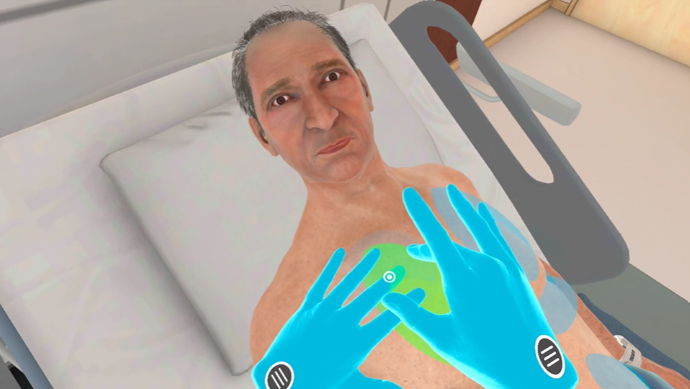
Enhanced Auscultation and Percussion Assessment
Explore UbiSim VR enhanced auscultation and new percussion assessment features built for nursing education

How Immersive VR Prepares Nurses for the Demands of Real Patient Care
Discover how immersive VR simulation builds clinical judgment and confidence in nurses using a real Med-Surg scenario as the guide.
%20(2).png)
The UbiSim Difference: Built, Designed, and Implemented by Nurses
Every step of the UbiSim experience is led by nurses. Discover what nurse-led VR simulation means for your nursing program.