Teaching Clinical Judgment With UbiSim Multiplayer VR
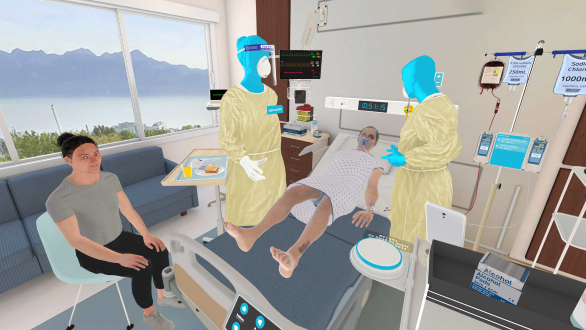
Table of Contents
Name of the heading 1
1- Start your table with the syntax {start-table}
2 - Add an H3 Heading to create a new column (this will be the column title)
3 - List cells as bullet points in a List element
4 - End your table with the syntax {end-table}
A patient’s breathing becomes labored. One nurse notices the change in respiratory rate; another hears diminished breath sounds; a third is preparing to call for help. Each holds part of the picture. What matters next is whether they share it, agree on a priority, and act together.
As a nurse educator, I’ve watched learners make solid individual observations but struggle to turn them into a shared plan. As a UbiSim customer success manager, I hear the same teaching goal from faculty: “I don’t just want learners to know what to do. I want them to communicate clearly when someone else is in the room.” That is where the multiplayer feature changes the learning experience.
UbiSim allows up to three active learners to care for the same virtual patient at once. They can assess the patient, exchange information in real time, and even hand one another objects such as a stethoscope. Rather than taking turns at an individual task, learners must decide who will assess, who will intervene, and when the team needs to change course.
How Teamwork and Communication Shapes Clinical Judgment at the Bedside
At the bedside, clinical judgment depends on what colleagues notice and whether concerns are heard. Multiplayer simulation gives educators a way to make this communication visible: Did someone voice the new finding? Did another learner acknowledge it? Did the team reconsider the plan when the patient’s condition changed?
Recent research highlights multiplayer VR simulation's potential to support teamwork development. In a 2023 trial involving 16 nursing and medical trainees, participants’ collaboration scores improved after a multiplayer VR experience. A separate 2025 trial found improved observed safety behaviors among surgeons after immersive VR teamwork simulation grounded in TeamSTEPPS principles. These studies support purposeful team practice while highlighting the need to evaluate what learners actually do.
Multiplayer in Practice: Turning Individuals Findings Into a Shared Plan
One nursing program I support started with just two headsets, but that didn’t stop the faculty from running numerous multiplayer sessions during scheduled simulation hours. By having two learners care for the same virtual patient, they made the most of their available equipment while giving learners opportunities to communicate, coordinate care, and make decisions together. They assigned responsibilities for assessment, medication, and procedures during pre-briefing. Their approach shows how facilitators can move from ‘let’s put two learners in VR’ to ‘what teamwork behavior do we want to observe?'
Let’s apply this concept to a COPD scenario: one learner assesses the patient’s breathing and lung sounds, another monitors oxygen saturation and vital-sign trends, and a third coordinates communication and completes the documentation. During the simulation, I evaluate how they connect their findings. If one learner notices increased work of breathing while another observes oxygen saturation trending downward, do they share their observations and agree on the next steps? In debriefing, I ask, “When did your individual assessments become a shared concern, and how did that change your plan?” These questions move the conversation beyond who completed each task to how the team used its collective observations to make a clinical judgment.
Plan Communication Goals From Pre-brief to Debrief
A strong multiplayer session begins before anyone puts on a headset. The INACSL Healthcare Simulation Standards of Best Practice call for preparation and pre-briefing before a simulation and a planned debriefing process afterward. I use this structure to make sure the technology supports the learning objectives.
- Pre-brief. Along with VR orientation and expectations for psychological safety, explain one or two observable goals for team communication. For example, voice a concerning assessment finding and confirm who is taking the next action.
- Determine roles. Assign the roles or let the learners negotiate them. Make it clear that the division of roles does not excuse anyone from speaking up about patient safety.
- Facilitate. Watch for missed cues, unclear delegation, and moments when the team successfully communicates and revises its plan.
- Debrief. Include both individual judgment and teamwork. Ask: “What changed your assessment? Who first noticed it? How did that information reach the rest of the team?”
Using TeamSTEPPS Tools in Multiplayer Debriefing
TeamSTEPPS 3.0 offers practical language for this work. A brief can establish the initial plan; a huddle can help learners regroup when the patient changes; SBAR can structure an escalation; and closed-loop communication can confirm that a request was heard and understood. The payoff is the chance to pause after a shared decision and ask, “How did we arrive there together?” That conversation can reveal the quiet learner who recognized the problem early, the confident learner who needed to listen, and the team that became safer when every learner contributed.

Give your learners hands-on clinical simulation training that builds confidence, improves decision-making, and prepares them for real-world patient care in a safe, scalable virtual environment.
FAQs
Heading 1
Heading 2
Heading 3
Heading 4
Heading 5
Heading 6
Lorem ipsum dolor sit amet, consectetur adipiscing elit, sed do eiusmod tempor incididunt ut labore et dolore magna aliqua. Ut enim ad minim veniam, quis nostrud exercitation ullamco laboris nisi ut aliquip ex ea commodo consequat. Duis aute irure dolor in reprehenderit in voluptate velit esse cillum dolore eu fugiat nulla pariatur.
Block quote
Ordered list
- Item 1
- Item 2
- Item 3
Unordered list
- Item A
- Item B
- Item C
Bold text
Emphasis
Superscript
Subscript
Voicing a concerning finding, confirming who takes the next action, escalating with SBAR, regrouping in a huddle when the patient’s condition changes, and closing the loop on requests.
This reframes the “What should I assess?” question. Answer it with debrief questions: “Who first noticed it? How did that information reach the rest of the team?”
Yes, if the scenario and participants fit the objective. For example, an RN and a respiratory therapist could work through a pediatric asthma scenario. Their objective might be to share assessment findings, clarify responsibilities, and agree on priorities as the child’s respiratory status changes.


Margaret "Maggie" Major is a dynamic educator and innovator in the field of nursing education. With an Ed.S. in Education specializing in Educational Technology from Walden University, Maggie brings a wealth of experience from her roles in secondary and post-secondary education. Her expertise spans curriculum development, online learning, and educational technology integration, making her an invaluable asset in advancing nursing education through cutting-edge simulation software. Her background as a Nurse Aide Program Coordinator and long-standing Adjunct Faculty member at Harrisburg Area Community College has given her unique insights into the evolving needs of nursing education. By championing the use of simulation and technology in nursing education, Maggie is playing a crucial role in shaping the future of healthcare education, preparing nurses who are confident, competent, and technologically adept for the challenges of modern healthcare delivery.
Explore more
What a UbiSim VR Simulation Partnership Looks Like
From picking VR software to building faculty confidence, here's what a real clinical partnership with UbiSim looks like, from a nurse who lives it daily.
The Benefits of AI Patient Dialogue in VR Nursing Simulation
AI patient dialogue brings real conversation practice to VR nursing simulation, building learner confidence and empathy while helping programs scale smarter
Enhanced Auscultation and Percussion Assessment
Explore UbiSim VR enhanced auscultation and new percussion assessment features built for nursing education