Table of Contents
Name of the heading 1
1- Start your table with the syntax {start-table}
2 - Add an H3 Heading to create a new column (this will be the column title)
3 - List cells as bullet points in a List element
4 - End your table with the syntax {end-table}
Physical assessment is one of the most nuanced skills a nursing student develops. It requires systematic technique, sharp interpretation, and the kind of repeated practice that builds real clinical confidence. In our June release, UbiSim takes a significant step forward in making that practice possible, with enhanced auscultation and brand-new percussion assessment capabilities that bring a new level of realism to the simulation environment.
What’s New
Expanded Lung Auscultation Zones
Expanded lung auscultation zones allow learners to perform more realistic and systematic respiratory assessments across anterior, posterior, and lateral lung fields. With each assessment zone individually configurable in the editor, educators can place findings in clinically relevant locations, helping reinforce best-practice assessment techniques and recognition of localized respiratory conditions, reflecting the standards your learners will encounter in clinical practice and on the NCLEX.
Where heart and lung assessment regions overlap, learners now hear both heart and lung sounds simultaneously. The layered audio experience: differentiating cardiac from respiratory findings in real time, is the kind of clinical nuance nurses encounter in practice and gives learners a critical opportunity to refine their assessment skills. Now it's built in.
Percussion Finally in VR
Percussion is commonly taught as part of respiratory and abdominal assessment, and it's long been a gap in VR-based simulation. It's a hands-on, tactile skill, and replicating it in a virtual environment is genuinely difficult.
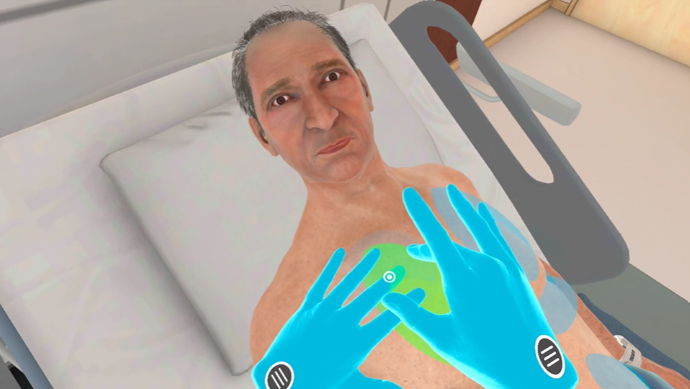
Percussion in UbiSim introduces dedicated hand poses and VR interactions designed to replicate real technique. Learners aren't just pressing a button or interacting with dropdown menus; they're engaging with the motion and positioning that make percussion a skill worth practicing. And just like in clinical practice, what they hear matters. Different percussion sounds —resonance, dullness, hyperresonance, and tympany— indicate different underlying anatomical and physiological findings, giving learners the opportunity to interpret what they're detecting and develop real clinical reasoning. The addition of percussion expands the range of physical assessment skills that can be practiced, observed, and evaluated within UbiSim.
Smarter Feedback and More Authoring Control
Both auscultation and percussion share the same underlying approach to feedback and scenario configuration.
Logged by Location, Ready for Review
Every assessment action is now captured with anatomical precision. Instead of a generic "performed auscultation" or "performed percussion," the system logs exactly where: Performed auscultation Right Upper Anterior Lung Field. Performed percussion Left Lower Posterior Lung.
That specificity gives educators a richer picture of learner behavior for debriefing — what was assessed, what was missed, and in what order. For learners, it's a clear record of their own technique that supports meaningful reflection.
More Control for Scenario Authors
In the editor, scenario authors can now configure location-specific findings for both auscultation and percussion, including lung sounds, volume levels, percussion findings by zone, checklist conditions, performance gap conditions, and session feedback integration. The result: patient presentations that are more clinically layered, more individualized, and more capable of challenging learners at every level.
Available Now Across Your Existing Scenarios
Both enhanced auscultation and percussion assessment are available across the UbiSim catalogue and in customer-authored scenarios. These aren't features locked to new content, they're platform-level capabilities you can bring to the scenarios you're already using.
They're also foundational to the new AI-enabled Solo Mode Health Assessment experiences that we will be introducing shortly.
How Better Physical Assessment Strengthens Your Nursing Program
Physical assessment education in simulation has often required compromise. Limited zones, simplified feedback, skills that couldn't be replicated in VR. With these updates, learners can now practice systematic respiratory, cardiac, and abdominal assessment with the kind of anatomical specificity that builds real competency. Educators have more tools to design challenging, clinically accurate patient presentations. And the simulation environment gets a little closer to the complexity of actual clinical practice.
That's the goal, and we're glad to keep building toward it with you.

Give your learners hands-on clinical simulation training that builds confidence, improves decision-making, and prepares them for real-world patient care in a safe, scalable virtual environment.
FAQs
Heading 1
Heading 2
Heading 3
Heading 4
Heading 5
Heading 6
Lorem ipsum dolor sit amet, consectetur adipiscing elit, sed do eiusmod tempor incididunt ut labore et dolore magna aliqua. Ut enim ad minim veniam, quis nostrud exercitation ullamco laboris nisi ut aliquip ex ea commodo consequat. Duis aute irure dolor in reprehenderit in voluptate velit esse cillum dolore eu fugiat nulla pariatur.
Block quote
Ordered list
- Item 1
- Item 2
- Item 3
Unordered list
- Item A
- Item B
- Item C
Bold text
Emphasis
Superscript
Subscript
Learners can practice systematic respiratory, cardiac, and abdominal assessment using anatomically accurate auscultation zones and percussion interactions. They develop the habit of thorough, zone-by-zone assessment, learn to differentiate between heart and lung sounds in real time, and interpret distinct percussion sounds—resonance, dullness, hyperresonance, and tympany—to identify underlying findings. Together, these features support the kind of deliberate, repeatable practice that builds real clinical confidence.
Yes, to access enhanced auscultation and percussion assessment, current UbiSim customers will need to update to UbiSim Version 1.21. Once updated, both features will be available to use across the UbiSim catalog.
Yes. Both auscultation and percussion are fully configurable in the UbiSim editor. Scenario authors can set location-specific findings, adjust lung sound types and volume levels, configure percussion results by zone, and integrate findings into checklists and performance gap conditions. Whether you're building a straightforward assessment scenario or a complex, abnormal patient presentation, the editor gives you the flexibility to match your curriculum goals.



Tracy's work sits at the intersection of clinical learning and product strategy helping the field understand not just what VR simulation can do, but why it matters right now. She is passionate about connecting innovation with real-world impact and championing nurses at the forefront of one of healthcare's most critical transformations.
Explore more

How Immersive VR Prepares Nurses for the Demands of Real Patient Care
Discover how immersive VR simulation builds clinical judgment and confidence in nurses using a real Med-Surg scenario as the guide.
%20(2).png)
The UbiSim Difference: Built, Designed, and Implemented by Nurses
Every step of the UbiSim experience is led by nurses. Discover what nurse-led VR simulation means for your nursing program.
From Make-Up Hours to Mastery: VR for Clinical Judgment
Discover how VR simulation moves nursing programs from seat-time compliance to measurable clinical judgment, with evidence to back it up.